How Search Engines Work: Crawling, Indexing, and Ranking Explained
Learn how search engines work, from crawling and indexing to ranking and search results. Discover how Google and Bing find, understand, and rank web pages.

Introduction#
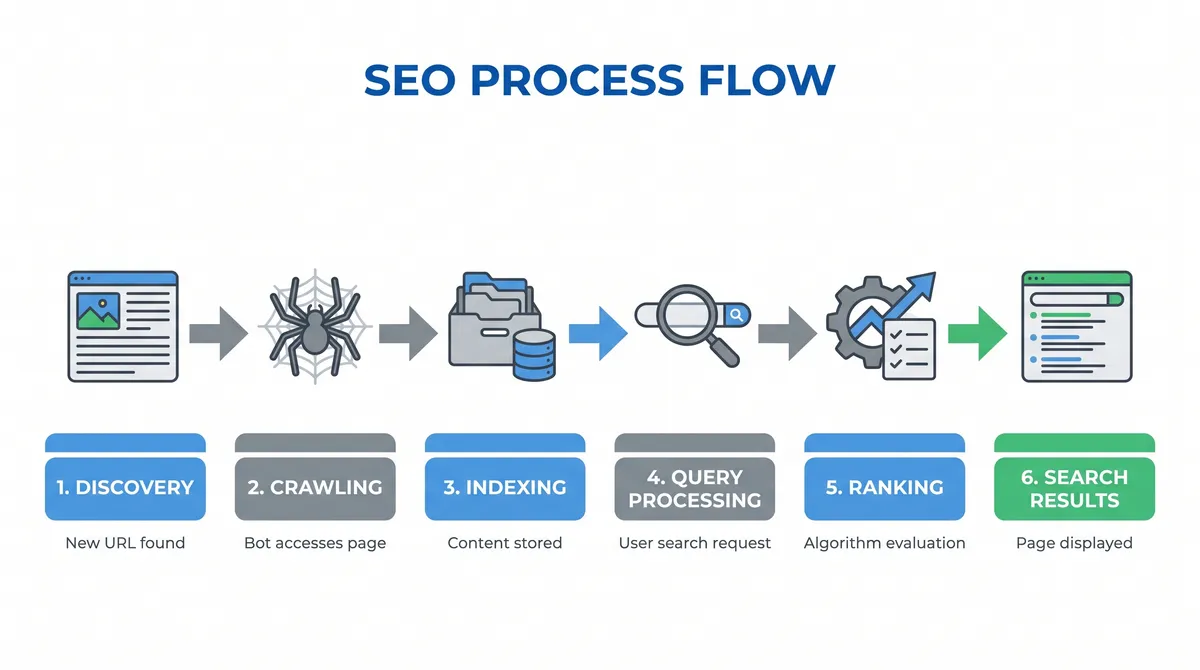
It is possible for search engines to find information among billions of web pages in just a few seconds. However, what occurs between the time a web page is published and the time it appears in the search results?
The process is best understood through three main stages: crawling, indexing, and ranking. To discover URLs, process page information, store it in an index, and then use automated ranking systems to choose and arrange results when a user searches, search engines use automated crawlers. Both Google and Bing regard their search services as fully automated systems, with Google describing Search this way and Bing likewise using crawlers to discover and process web content.
By understanding these stages, website owners can identify SEO problems and create pages that search engines can discover, understand, and potentially display to users.
<a id="what-are-search-engines"></a>
What Are Search Engines?#
A search engine is a system which helps people to find information on the Web.
Google, Bing, and other search engines have large databases, usually called search indexes, that include information about the web pages and other content they have discovered and processed.
Normally, when you enter a query, the search engine does not scan the whole live internet from scratch but instead searches the information it has already collected and processed.
The company says that when a user enters a query, its machines search its index and then present the results its systems judge to be relevant and useful.
A simplified model looks like this:
Web pages → Crawling → Processing → Indexing → Query understanding → Ranking → Search results
This distinction matters because publishing a page does not ensure that it will appear in relevant search results.
<a id="how-search-engines-work-at-a-high-level"></a>
How Search Engines Work at a High Level#
Search engines generally perform several connected tasks:
- Discover URLs
- Crawl pages
- Process and render content when necessary
- Understand and organize information.
- Store eligible information in an index
- Interpret a user's search query.
- Retrieve potentially relevant results.
- Rank and present results
- Generate the search-result experience.
According to Google's documentation, crawling and indexing are separate processes, and it states that websites based on JavaScript involve crawling, rendering, and indexing.
This implies that SEO involves more than inserting keywords into a page; the search engine must first discover and access the page, then understand it, and finally decide whether it is a useful result for a given query.
<a id="what-is-crawling"></a>
What Is Crawling?#
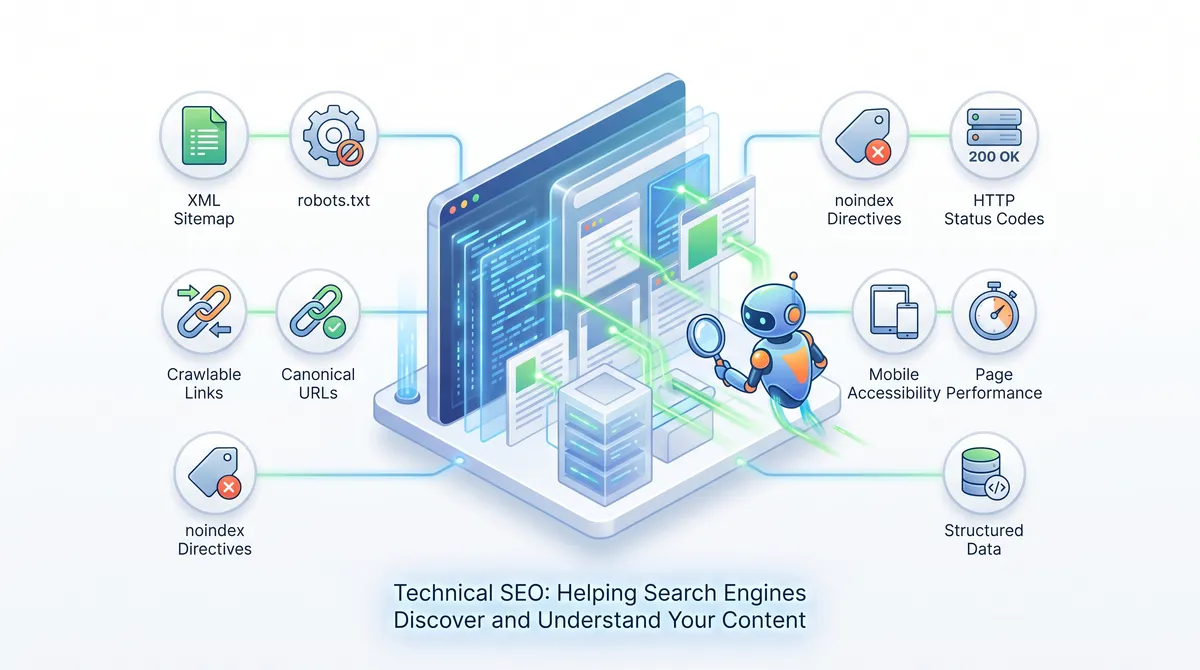
Crawling involves discovering and retrieving web pages and resources.
Search engines use automated programs known as crawlers, bots, or spiders.
Google uses crawlers such as Googlebot, while Bing uses Bingbot. Bing says Bingbot is the crawler that locates new and updated pages so it can include them in its index.
Imagine you publish an article on technical SEO.
The search engine may discover its URL through:
- A link from another page
- An internal link on your website
- A sitemap
- Previously known URLs
- Other discovery mechanisms
The crawler then requests the page and receives both its content and the technical responses.
Just because something crawls doesn't mean that it will rank.
A page can be crawled without being indexed, and a page can be indexed without ranking highly for a given query.
What does a search engine crawler examine?
Depending on the page and search engine, crawlers can process information such as:
- HTML
- Text
- Links
- Images
- Metadata
- Structured data
- HTTP status codes
- Canonical signals
- Robots directives
- JavaScript-generated content
- Other accessible resources
Google's documentation on crawling and indexing includes sections on robots.txt, sitemaps, canonicalization, JavaScript, metadata, crawl management, and crawlable links.
<a id="how-search-engines-discover-new-urls"></a>
How Search Engines Discover New URLs#
Before they can crawl them, search engines need ways to discover URLs.
Internal Links
Internal links connect pages within the same website.
For example:
Homepage → Blog → SEO Guide → Technical SEO Guide
A logical internal link structure helps search engines identify related pages and understand their relationships.
External Links
Links from other websites can also help search engines discover URLs.
Yet links are not merely a means of submission. Search engines have their own methods of crawling and discovering web pages.
XML Sitemaps
An XML sitemap gives a search engine information about URLs a website considers important.
Google states that a sitemap can help it discover URLs, particularly for newly launched websites or those that have changed. Yet submitting a sitemap does not ensure that the pages will be indexed or lead to an improved ranking on its own.
RSS and Other Feeds
Some websites also provide feeds that can help search systems find newly published or updated content.
The important concept is simple:
A search engine may crawl a URL through discovery, but that doesn't mean it will include the URL in the index or rank it.
<a id="what-is-search-engine-indexing"></a>
What constitutes search engine indexing?#
Indexing involves analyzing and storing information about crawled content so it can be retrieved during a search.
Imagine an index as a well-organized library.
It is similar to searching for and gathering books.
Indexing is just like reading, sorting, arranging, and cataloging them.
When a search engine looks at a webpage, it can assess details about the page's content, structure, links, metadata, and other signals.
Google states that it can index a wide variety of page types and files, and its systems can also detect duplicate or highly similar pages to choose a canonical URL.
Does Crawled Mean Indexed?
No.
This is one of the most important SEO concepts.
Even if a crawler accesses a page, it may still not end up in the search index.
Potential reasons can include:
- The page has a noindex directive.
- Technical issues affect the page.
- The content is not available, or you can't access it.
- The page is heavily duplicated.
- Search engines conclude that the page does not need to be indexed.
- The website is quite new and hasn't been fully processed yet.
- Other quality, spam, or technical factors may affect eligibility.
Google makes it clear that crawling and indexing take time, and that it offers no assurance that a given URL will be crawled or indexed.
<a id="how-search-engines-understand-a-web-page"></a>
How Search Engines Understand a Web Page#
Modern search engines go beyond matching exact words.
They try to grasp the content, subject, meaning, the relationships between various elements, and the context of both the pages and the queries.
For JavaScript websites, Google documents a process involving:
- Crawling
- Rendering
- Indexing
Rendering helps Google process content that depends on JavaScript.
Search engines can also use signals such as:
- Page text
- Headings
- Links
- Structured data
- Images and image context
- Page titles
- Language
- Geographic relevance
- Query meaning
- Relationships between pages
Structured data can help Google understand specific information about a page and may make the content suitable for various enhanced search features.
<a id="what-is-search-engine-ranking"></a>
What does search engine ranking entail?#
Ranking involves deciding which eligible results to display for a given search query and in what order.
Suppose someone searches:
“how to improve website SEO”
A search engine can identify anywhere from thousands to millions of potentially relevant documents.
It then employs automated systems to identify the results that best meet the searcher's needs.
Google says its ranking systems use several signals and systems to display relevant, useful results. The company also stresses that rankings are carried out programmatically, not by paying to achieve higher organic positions.
Ranking is therefore query-dependent.
The page can come up at different positions for different searches.
It can rank highly for a particular query that is closely related while showing up much lower or not at all for a more general query.
<a id="what-factors-affect-search-rankings"></a>
What factors influence search rankings?#
Website owners cannot focus on optimizing a single universal "ranking score".
Google uses multiple ranking systems and signals that work together. Google documents systems for language understanding, links, freshness, original content, passage understanding, and neural matching.
Important areas for SEO include:
Relevance
The page must consider both the meaning and intention behind the user's query.
Helpful, Original Content
Content should offer useful information rather than mainly aiming to manipulate search traffic.
Content Quality
A page needs to be accurate, easy to understand, useful, and suitable for its subject matter and intended audience.
Links and Site Structure
Internal links help search engines discover pages and understand relationships between them, and external links can also signal the web's structure and relationships.
Google documentation states that link-analysis systems, such as PageRank, are still included in its main ranking systems, even though these systems have changed considerably over time.
Freshness
Certain queries do better with more up-to-date information.
For instance, someone looking for a current event usually needs up-to-date information rather than an old article.
Google uses freshness systems to show newer content when a search needs up-to-date information.
Page Experience
Google advises you to consider the overall experience users have when accessing a page, such as mobile usability, security, Core Web Vitals, intrusive elements, and the accessibility of the main content.
Don't treat SEO as a list of separate ranking factors; search systems consider many signals together.
<a id="crawling-vs-indexing-vs-ranking"></a>
Crawling vs Indexing vs Ranking#
Although the three concepts are related, they are different.
| | | | | --- | --- | --- | | Crawling | Discovering and fetching a URL | Googlebot visits your article | | Indexing | Processing and storing information about the page | Google adds useful information about the article to its index | | Ranking | Selecting and ordering results for a query | The article appears in a particular position for a search |
A useful way to remember the difference is:
Crawl = Find it
Index = Understand and store it.
Rank = Decide where it may appear
A fourth concept is also useful:
Serve = Show the appropriate result or search feature to the user.
<a id="why-a-page-may-not-appear-in-search"></a>
Why a Page May Not Appear in Search#
Just because an article is published doesn't mean that it will show up in Google or Bing.
Common technical and content-related issues include:
1. The page has not been found.
Search engines won't crawl a page if they don't know the URL exists.
2. Crawling Is Blocked
A misconfigured robots.txt file may prevent web crawlers from accessing certain URLs or resources.
3. The page has noindex assigned to it.
A noindex directive will cause compatible search engines to exclude the page from their index.
Both Google and Bing have mechanisms for controlling indexing through robot directives and related controls.
4. There are technical problems with the page.
Server errors, unavailable resources, incorrect redirects, and other technical issues may interfere with crawling and processing.
5. Duplicate Content
If several URLs include content that is considerably similar to other URLs, search engines might group them and choose one canonical URL.
Google states that its systems can group duplicate or highly similar pages and then select a canonical URL based on the signals gathered during processing.
6. The page does not correspond to the query.
A page may be included in the index yet still fail to appear prominently since it is not seen as being sufficiently relevant to a given search.
Google makes it clear that pages included in its index might not appear in search results for reasons such as relevance and content quality.
<a id="how-seo-helps-search-engines"></a>
How SEO Helps Search Engines#
The goal isn't to make a search engine rank a page.
Good SEO helps search engines discover, crawl, understand, and interpret a website, while also improving the user experience.
Useful SEO practices include:
- Creating descriptive page titles
- Writing clear headings
- Using logical URLs
- Building useful internal links
- Creating helpful, original content
- Maintaining an XML sitemap
- Managing robots.txt correctly
- Using canonical URLs when appropriate
- Making important links crawlable
- Fixing major technical errors
- Making pages accessible on mobile devices
- Improving page performance
- Using structured data where appropriate
- Keeping important information accurate and current
The Google SEO Starter Guide stresses the importance of practices that help search engines crawl, index, and understand website content.
The aim is not to adhere to a made-up formula.
The aim is to ensure that your website is easy for both people and search systems to understand.
<a id="how-ai-and-modern-search-are-changing-discovery"></a>
How AI and Modern Search Are Changing Discovery#
Search is now more than a list of conventional blue links.
Modern search experiences can include:
- AI-generated answers
- Conversational search
- Knowledge panels
- Images
- Videos
- News
- Local results
- Featured snippets
- Product results
- Other specialized search features
Google's current Search documentation covers both AI features and more traditional topics related to search appearance.
Bing has likewise gone beyond traditional search performance in webmaster reporting. In 2026, Microsoft announced a preview of AI Performance in Bing Webmaster Tools, which illustrated how publisher content can be referenced in certain Microsoft AI experiences.
The basic principles still matter.
Search systems need to:
Discover → Fetch → Understand → Organize → Retrieve → Select → Present
This means that for publishers, clear information architecture, accessible content, useful answers, descriptive entities, and technically accessible pages all become more important.
<a id="how-to-make-a-website-easier-to-crawl-and-index"></a>
How to Make a Website Easier to Crawl and Index#
When launching or improving a website, use this practical checklist.
Step 1: Build a Logical Site Structure
Sort content into useful groups.
For example:
Website → SEO → Technical SEO → Crawling
This arrangement helps visitors navigate the site and gives search engines useful contextual relationships.
Step 2: Create Useful Internal Links
Link related pages naturally.
Don't add links just because you want to; the page they lead to should be useful to the reader.
Step 3: Maintain Your Sitemap
Make sure your XML sitemap is accurate and includes the important URLs.
A sitemap may aid discovery but does not ensure a page will be indexed or ranked.
Step 4: Check Robots.txt
Make sure essential content isn't accidentally blocked.
Step 5: Check Noindex Directives
Review key pages for any accidental noindex instructions.
Step 6: Use Canonicalization Correctly
If several URLs point to the same or very similar content, use the correct canonical signals and a proper site architecture.
Step 7: Fix Server and Crawl Problems
Monitor errors such as 4xx and 5xx response codes, redirects, DNS problems, and availability issues.
Step 8: Publish Useful Content
While technical accessibility is necessary, it does not replace useful content.
Google suggests focusing on producing high-quality content that is valuable to users.
<a id="how-to-check-whether-google-has-indexed-your-page"></a>
How to Check Whether Google Has Indexed Your Page#
Several methods can help you investigate indexing.
Use Google Search Console
Search Console includes tools that let you see how Google handles your URLs.
The URL Inspection tool helps website owners investigate a specific page's indexing status and request crawling when appropriate.
Google makes it clear that asking it to crawl a page does not ensure that it will be included or ranked immediately.
Use a site: Search
You can search:
site:example.com
This can provide clues about pages Google has indexed.
Yet Google warns that the site: operator does not always return every URL it has indexed.
Check Bing Webmaster Tools
Bing offers URL Inspection and Site Explorer tools that you can use to investigate problems related to crawling, indexing, SEO, and URL status.
<a id="common-search-engine-myths"></a>
Common Search Engine Myths#
Myth 1: Submitting a Sitemap Guarantees Rankings
False.
A sitemap helps search engines discover URLs, but Google has made it clear that submitting a sitemap does not guarantee a page will be indexed or improve its ranking.
Myth 2: Crawling More Means Ranking Higher
False.
Although crawling is necessary for search visibility, crawl frequency does not determine rankings.
Google has said that increasing crawl frequency does not necessarily lead to better search rankings.
Myth 3: More Keywords Always Produce Better Rankings
False.
Modern search systems consider meaning, relevance, content quality, and other factors. Simply repeating keywords unnaturally can make content less, not more, useful.
Myth 4: Every Indexed Page Will Rank for Its Target Keyword
False.
Indexing makes a page retrievable, while ranking depends on the query and the search engine's ranking systems.
Myth 5: Search Engines Only Read Text
False.
Search engines can process various types of content and page resources; for instance, Google's documentation covers images, JavaScript, structured data, metadata, and many other elements.
<a id="search-engine-workflow-example"></a>
Search Engine Workflow Example#
Imagine you publish an article titled:
“How to Improve Technical SEO for a New Website”
Here's a simplified account of what might happen.
Stage 1: Discovery
Google finds the URL via an internal link, a sitemap, or another source.
Stage 2: Crawling
Googlebot requests the URL and obtains the page.
Stage 3: Processing
The search engine works through the HTML and other accessible resources and, if needed, also renders the JavaScript.
Stage 4: Indexing
The search engine reviews the page and may store some information about it in its index.
Stage 5: Query
A user searches:
“technical SEO for a new website”
Stage 6: Retrieval and Ranking
The search engine finds pages that may be relevant, then applies its ranking methods to decide which results best match the query.
Stage 7: Search Result
Your article may appear as if it were naturally produced, and it may show up alongside other results depending on the query.
The main thing to note is that SEO doesn't influence every stage.
You can improve technical accessibility, content quality, structure, and relevance, but search engines will still make their own automated decisions.
FAQs About How Search Engines Work#
1. What is the way in which search engines function in simple terms?
Search engines find web pages by crawling, analyze and organize the information through indexing, and use automatic ranking systems to decide which results to display in response to a user's query.
2. What is the difference between crawling and indexing?
Crawling consists of locating and retrieving web pages. Indexing is the process of processing information about those pages and storing it so search results can retrieve the content.
3. What does search engine ranking consist of?
Search engine ranking consists of choosing and arranging search results relevant to a given query. To decide which results are suitable, search engines use multiple signals and automated systems.
4. What method do search engines use to find new websites?
Search engines can find websites and URLs through links, sitemaps, feeds, previously known URLs, and other discovery methods. Although a sitemap may aid in discovery it does not ensure indexing.
5. How long does it take Google to crawl and index a new page?
There is no definite universal time frame; Google has stated that it may take a while to crawl and index a site and cannot guarantee when or whether a given URL will be crawled or indexed.
6. Can a page be included in an index without being ranked?
Certainly, indexing differs from ranking; a page may be indexed but still not appear prominently in results for a given query if other pages are considered more relevant or useful.
7. Does SEO promise better rankings?
SEO can make a website more accessible, improve its structure, clarify its content, and help search engines understand it. Still, no genuine SEO technique can guarantee a specific ranking position.
8. Does Google rank websites or individual pages?
Google's ranking systems primarily work at the individual-page level, although site-wide signals and classifiers can also influence how it understands those pages.
9. What is Googlebot?
Googlebot is Google's web crawler; it discovers and retrieves web content so Google's systems can process it for use in Search.
10. What is Bingbot?
Bingbot is the web crawler used by Bing, and the company describes it as the crawler responsible for locating newly added or updated pages so they can be processed and indexed.
Conclusion#
It is much easier to understand how search engines work if you break the process down into its main stages.
Crawling enables search engines to discover and retrieve content.
Indexing involves processing and organizing information about that content.
The system decides which of the qualifying results are most relevant to a given search query and the order in which they should appear.
SEO supports these processes by making it easier for websites to be found, crawled, understood, and used. This includes a well-structured site, useful internal links, accessible content, accurate metadata, sensible technical setup, useful content, and a good user experience.
The key point is that being crawled, being indexed, and ranking are three separate matters. An effective SEO strategy considers all three rather than focusing only on keywords or rankings.
Search is still developing, with AI-driven search experiences as one part of that development. Still, the basic requirement stays the same: search systems have to find information, understand it, and connect it with the people looking for it.