Search Intent Explained: 4 Types of Search Intent in SEO
Learn what search intent is, the 4 types of search intent, real examples, and how to match your SEO content to what users actually want.

Search Intent Types
Search engines help people find information, products, services, websites, and answers. But what really matters behind every search is the user's intent.
When someone searches for “what is cloud computing,” they probably want an explanation.
When someone searches for “AWS login,” they are probably trying to reach a particular website or page.
When someone searches for “best cloud hosting for WordPress,” they are researching options.
And when they search for “buy cloud hosting,” they are much closer to taking a transaction-oriented action.
The words might look like regular keywords, but what the user wants can be very different.
That is why search intent matters in SEO.
Google's Search Essentials highlights the importance of making helpful, reliable, people-first content and using language that matches how people actually search. Google also says it chooses search results based on relevance and other signals, not just matching exact words.
When you understand search intent, you can make pages that truly answer what people are looking for, instead of just repeating a keyword.
What Is Search Intent?#
Search intent is the underlying purpose or goal behind a user's search query.
“How to Determine Search Intent”
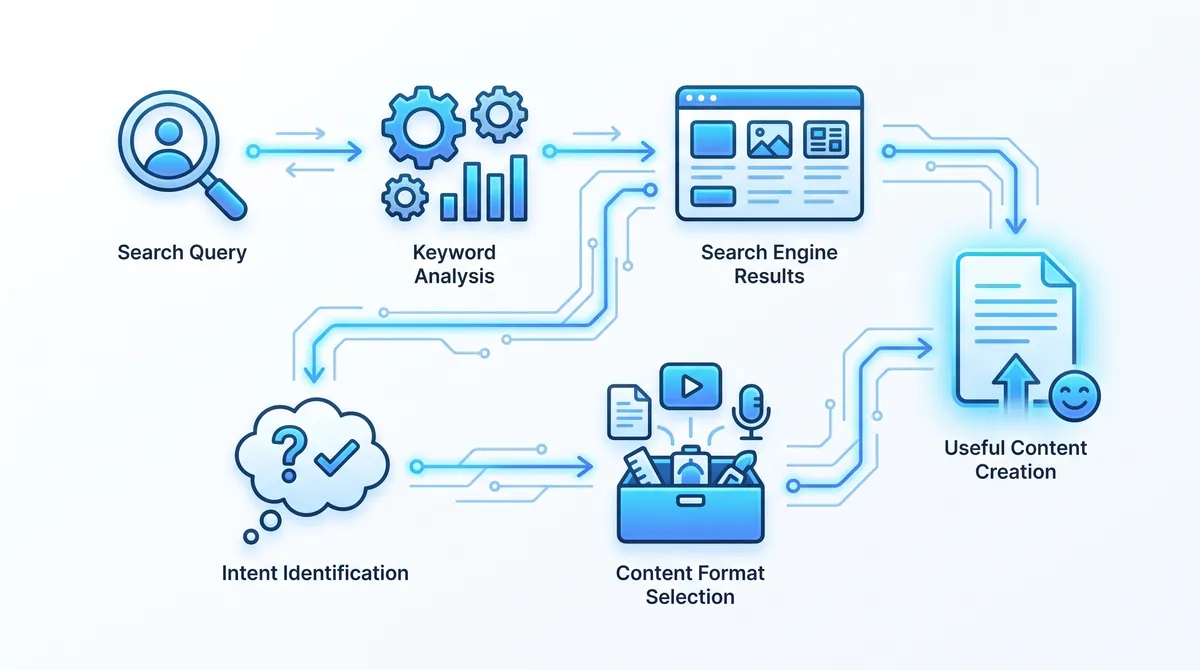
In other words, it answers one simple question:
"“Why did this person perform this search?”
A user might want to:
- Learn something
- Find a specific website.
- Compare products or services.
- Purchase something
- Solve a problem
- Find instructions
- Research before making a decision
SEO professionals commonly group these purposes into four major categories:
- Informational
- Navigational
- Transactional
- Commercial investigation
SEO platforms and practitioners use these four categories widely, although some searches can include more than one intent.
Why Does Search Intent Matter in SEO?
Search intent is important because ranking for a keyword doesn't help if your page doesn't give the searcher what they want.
Imagine someone searches:
“How to fix a leaking faucet”
The user wants instructions.
If your page starts with a big ad for your plumbing services and a long description of your company, it might be about plumbing but still won't help the user fix their problem right away.
This shows the difference between just matching keywords and actually meeting the user's intent.
Google's current guidance emphasises content that is helpful, reliable, comprehensive, and created primarily for people rather than to attract search traffic.
Search intent can influence:
- Keyword selection
- Content format
- Search snippets
- Blog topics
- Product pages
- Landing pages
- Category pages
- Calls to action
- Internal linking
- Conversion strategy
- Overall content architecture
It also helps prevent a classic SEO disaster: creating a beautiful page for the wrong search intent.
Even though computers can understand intent and s optimise for it, progress isn't always simple.
The 4 Types of Search Intent
Here is the basic framework:
| Informational | Learn something | “what is SEO” | Guide, article, tutorial | | --- | --- | --- | --- | | Navigational | Find a specific destination | “Google Search Console” | Website, brand page | | Transactional | Complete an action | “buy running shoes” | Product/service page | | Commercial Investigation | Compare options before deciding | “best SEO tools” | Comparison, review, buyer's guide |
Let's examine each one.
1. Informational Search Intent
Informational intent means the user is looking for information, an explanation, an answer, or instructions.
These searches usually involve learning rather than completing a transaction immediately.
Examples
- What is SEO?
- How does cloud computing work?
- What is Kubernetes?
- How to create a website
- Why is my laptop overheating?
- SEO vs SEM
- What is search intent?
Common informational modifiers
Users frequently use words such as:
- What
- Why
- How
- When
- Where
- Who
- Guide
- Tutorial
- Explanation
- Meaning
- Examples
- Benefits
- Tips
These words can give you hints, but they're not strict rules. Looking at real search results gives a better idea of what people want.
Best content formats
Informational searches commonly work well with:
- Blog posts
- Tutorials
- Step-by-step guides
- Beginner's guides
- Definitions
- Educational resources
- How-to articles
- Explainers
- FAQ content
Example
Keyword:
“How does solar battery storage work”
A suitable page would explain:
- What solar battery storage is
- How batteries store electricity
- How charging works
- How stored electricity is used
- Battery types
- Benefits and limitations
- Typical system considerations
A product sales page by itself probably won't answer all the user's questions.
2. Navigational Search Intent
Navigational intent occurs when someone is trying to reach a particular website, brand, company, platform, or webpage.
For example:
- YouTube
- Facebook login
- Google Search Console
- Ahrefs login
- Amazon
- OpenAI ChatGPT
Usually, the user already knows where they want to go. They're just using the search engine to get there.
Search engines can identify these searches based on the query and the results associated with the requested destination.
Examples
| “YouTube” | Navigational | | --- | --- | | “Amazon login” | Navigational | | “Google Search Console” | Navigational | | “Ahrefs” | Navigational | | “University of Ruhuna website” | Navigational |
How businesses should handle navigational intent
If users search for your brand, make sure your website provides clear pages for important destinations such as:
- Homepage
- Login
- Contact
- Pricing
- About
- Documentation
- Support
- Product pages
Branded searches can also overlap with other intents.
For example:
“Ahrefs pricing”
It includes a brand name, but the user is really looking for pricing, which is more transactional.
That is why you shouldn't determine intent purely from the presence of a brand name.
3. Transactional Search Intent
Transactional intent means the user is ready to take a specific action.
That action is often a purchase, but it doesn't have to be.
The user might want to:
- Buy a product
- Subscribe to a service.
- Download something
- Register
- Book something
- Start a free trial
- Request a quote
Examples
- Buy iPhone 17 Pro
- Buy running shoes online.
- AWS pricing calculator
- Subscribe to Netflix
- Download Ubuntu
- Book a hotel
- SEO audit service
Transactional keywords often contain strong action-oriented terms such as:
- Buy
- Purchase
- Order
- Price
- Pricing
- Discount
- Coupon
- Subscribe
- Download
- Book
- Hire
- Quote
But just looking at these words isn't enough. You still need to check the search results.
Best content formats
Transactional searches generally call for pages such as:
- Product pages
- Service pages
- Pricing pages
- Checkout pages
- Booking pages
- Registration pages
- Download pages
- Commercial landing pages
If someone searches for “buy wireless headphones online,” giving them a long history of headphones would completely miss what they're looking for.
4. Commercial Investigation Search Intent
Commercial investigation sits between learning and purchasing.
The searcher is considering a product, service, or solution but wants more information before deciding.
Think:
“I might buy this, but I want to investigate first.”
Examples
- Best SEO tools
- Best laptops for students
- Ahrefs vs Semrush
- Best cloud hosting
- WordPress hosting comparison
- iPhone vs Samsung
- Best project management software
- Semrush review
Common commercial modifiers
- Best
- Top
- Review
- Comparison
- Vs
- Alternative
- Alternatives
- Pros and cons
- Features
- Pricing
- Which is better?
Best content formats
Commercial investigation queries often work well with:
- Comparison articles
- Product reviews
- Buyer's guides
- “Best” lists
- Alternatives pages
- Feature comparisons
- Pros-and-cons articles
- Case-based comparisons
For example:
“best SEO tools for small businesses”
isn't necessarily asking the searcher to purchase immediately.
They may want to understand:
- Features
- Pricing
- Ease of use
- Keyword research capabilities
- Technical SEO features
- Reporting
- Limitations
- Ideal user
- Alternatives
This is a very different need compared to someone searching for “buy SEO software.”
Search Intent Examples
Let's put the four categories side by side.
| What is Kubernetes? | Informational | Learn | | --- | --- | --- | | How does Kubernetes work? | Informational | Understand | | Kubernetes documentation | Navigational | Find documentation | | Kubernetes pricing | Commercial/Transactional | Research or purchase | | Best Kubernetes platforms | Commercial | Compare | | Kubernetes vs Docker | Commercial/Informational | Compare and learn | | Buy Kubernetes training course | Transactional | Purchase | | Docker Hub | Navigational | Visit a destination |
The important point is that the same topic can produce different search intents.
“SEO” is a topic.
But:
- “What is SEO?” → informational
- “Best SEO tools” → commercial investigation
- “Semrush login” → navigational
- “Buy SEO software” → transactional
Knowing this difference helps when planning your SEO content strategy.
How to Determine Search Intent
The most reliable practical method is to study the search results for the target keyword.
Why?
Because search engines are already trying to determine what users want.
Search-intent research commonly involves examining the dominant content type, format, and angle appearing in the SERP. Ahrefs describes these as the 3 Cs of search intent.
Step 1: Search the Keyword#
Enter your target query into Google.
For example:
“best website builders”
Don't immediately start writing.
First, inspect the results.
Step 2: Analyse the Content Type#
Ask:
What types of pages dominate the results?
Are they:
- Blog articles?
- Product pages?
- Category pages?
- Service pages?
- Forums?
- Official websites?
- Videos?
- Comparison pages?
If most results are detailed comparison articles, making a basic service landing page probably won't match what users want.
Step 3: Analyse the Content Format#
Look at the structure of ranking pages.
Are they:
- Tutorials?
- Reviews?
- Comparisons?
- Lists?
- Step-by-step guides?
- Definitions?
- Product pages?
For example:
“best laptops for programming”
This usually means you should create a comparison article, not just a general piece called “What Is a Laptop?”
Step 4: Analyse the Content Angle#
The content angle is the particular perspective emphasised by the ranking results.
For example, results might emphasise:
- Beginners
- Low cost
- Professional users
- Small businesses
- Speed
- Ease of use
- Latest models
- Specific geographic markets
Knowing this helps you make content that really fits what the searcher is looking for.
Can One Keyword Have Multiple Search Intents?
Yes.
This is one of the most important things to understand about search intent.
Not every keyword fits neatly into one box.
For example:
“best air fryer”
could involve:
- Informational intent because the user wants to learn about options
- Commercial investigation because they are comparing products
- Transactional intent because they may be close to purchasing
SEO tools themselves can classify keywords with multiple intent attributes, and current SEO research explicitly recognises mixed-intent queries.
Another example is:
“iPhone 18 Pro”
Someone could want:
- Specifications
- Reviews
- Price
- Comparison
- Where to buy
- Official Apple information
So don't think of intent categories as strict rules.
They're just helpful frameworks.
The search results show what people are really looking for.
How to Match Content to Search Intent
Once you've identified intent, your page should satisfy the user's underlying goal.
Informational → Teach
Create:
- Guides
- Tutorials
- Explanations
- Educational articles
- FAQs
Navigational → Help Them Reach the Destination
Create or optimise:
- Homepage
- Brand pages
- Login pages
- Documentation
- Contact pages
- Specific destination pages
Commercial → Help Them Compare
Create:
- Reviews
- Comparisons
- Buyer's guides
- Alternatives
- Feature breakdowns
Transactional → Help Them Act.
Create:
- Product pages
- Service pages
- Pricing pages
- Checkout experiences
- Booking pages
- Signup pages
The main idea is simple:
"Give the searcher the type of page they are actually looking for.
Search Intent and Keyword Research
Search volume alone isn't enough when selecting keywords.
Imagine two keywords:
| “what is SEO” | High | Informational | | --- | --- | --- | | “SEO audit service” | Lower | Transactional |
If you're building an SEO agency, the second keyword could potentially be more commercially relevant to your business even if the first attracts more searches.
This is why keyword research should consider:
- Search volume
- Competition
- Relevance
- Business value
- Search intent
- SERP characteristics
- Content requirements
Intent helps you see what kind of opportunity a keyword offers, instead of treating every search as just a number in a tool.
Common Search Intent Mistakes
1. Optimising Only for Keyword Density#
Repeating a keyword over and over won't turn a mismatched page into something useful.
Google's guidance emphasises helpful content and natural language over creating content primarily for search-engine manipulation.
2. Ignoring the SERP#
If Google consistently displays comparison pages for a query, publishing a generic 500-word article may not be enough.
Study what currently ranks.
3. Creating the Wrong Page Type#
A product page isn't automatically the right answer for every product-related keyword.
Some users are still researching.
4. Treating Every Keyword as One Intent#
Mixed intent is common.
Don't force every keyword into a single rigid category.
5. Writing for Search Engines Instead of People#
Google explicitly recommends creating people-first content rather than content primarily designed to attract search-engine traffic.
The objective isn't:
“How many times can I put my keyword here?”
It is:
“Did I actually solve the searcher's problem?”
Focusing on solving the searcher's problem usually leads to much better content.
Search Intent SEO Checklist
Before publishing a page, ask:
Keyword
- What is the primary keyword?
- What related terms are relevant?
- What questions does the searcher have?
Intent
- Is the intent informational?
- Navigational?
- Transactional?
- Commercial investigation?
- Could the keyword have mixed intent?
SERP
- What content types dominate?
- What formats dominate?
- What topics do ranking pages cover?
- What content angle appears repeatedly?
- What SERP features appear?
Content
- Does the page answer the primary question quickly?
- Does it provide enough depth?
- Does the format match the SERP?
- Does it provide original value?
- Does it satisfy the user's next likely question?
Conversion
- Is the CTA appropriate for the user's stage?
- Are internal links relevant?
- Does the page naturally guide users toward the next step?
Frequently Asked Questions About Search Intent
What is search intent in SEO?#
Search intent is the reason or purpose behind a user's search query. It describes what the searcher is trying to accomplish, such as learning something, finding a website, comparing options, or completing a transaction.
What are the four types of search intent?#
The four commonly recognised categories are informational, navigational, transactional, and commercial investigation. These categories provide a useful framework for understanding what users want from a search.
What is informational search intent?#
Informational intent occurs when a user wants to learn something, find an answer, understand a concept, or follow instructions. Queries often include terms such as “what,” “why,” “how,” “guide,” or “tutorial.”
What is navigational search intent?#
Navigational intent occurs when a user wants to reach a specific website, brand, platform, or webpage. Examples include searches such as “YouTube,” “Amazon login,” or “Google Search Console.”
What is transactional search intent?#
Transactional intent indicates that a user wants to complete an action, often purchasing a product or service. Queries may contain terms such as “buy,” “price,” “order,” “subscribe,” or “book.”
What is commercial investigation intent?#
Commercial investigation intent occurs when someone is researching products or services before making a decision. Examples include “best SEO tools,” “iPhone vs Samsung,” and “Ahrefs alternatives.”
Can a keyword have multiple search intents?#
Yes. Some keywords have mixed intent. A search such as “best laptops” can involve both informational and commercial investigation intent because the user may want information while comparing products before purchasing.
How do I find the search intent of a keyword?#
Search the keyword and examine the current SERP. Look at the dominant content type, format, and angle. Comparing the ranking pages can reveal what search engines appear to consider relevant for that query.
Does search intent affect SEO rankings?#
Matching search intent is an important part of creating relevant content, but it is not a standalone guarantee of rankings. Google uses many signals and systems to determine which results are relevant and useful for a query.
Is search intent the same as keyword intent?#
The terms are often used interchangeably. In practical SEO workflows, “keyword intent” can refer to the intent associated with a keyword during research, while “search intent” emphasises the user's purpose behind the actual query.
How Search Intent Fits Into Modern SEO
Search intent is more than just a keyword research label.
It links what people are searching for to what your website should offer.
A strong SEO workflow therefore looks something like this:
Keyword → Search Intent → SERP Analysis → Content Type → Content Format → Useful Content → Internal Links → Appropriate CTA
This approach also aligns with Google's broader guidance on people-first content. Google says valuable, unique, useful content can help both traditional Search and its generative AI search experiences, while creating large amounts of repetitive content primarily to manipulate rankings is not the recommended approach.
The main takeaway is simple:
Don't make content just because a keyword is popular. Make content that truly meets the reason someone searched for it.
Conclusion
Search intent is the “why” behind a search query.
The four major categories are:
- Informational: “I want to learn.”
- Navigational: “I want to find something.”
- Commercial investigation: “I want to compare before deciding.”
- Transactional: “I want to take action.”
For SEO, the most practical way to understand intent is to combine the keyword itself with SERP analysis. Look at what Google currently displays, identify the dominant content type and format, and then create a page that genuinely satisfies the searcher's goal.
Also, keep in mind that intent isn't always clear-cut. Some searches are mixed, and real search behavior is often messier than these four categories.
In the end, good SEO isn't about fooling search engines into thinking your page is relevant.
It's about making your page truly relevant.
The optimisation part comes afterwards.