What Are Keywords in SEO? Complete Keyword Research Guide
Learn what keywords are in SEO, why they matter, search intent, keyword types, and how to do keyword research step by step.

What are keywords in SEO?#
The terms used in SEO are words and phrases which indicate what people search for when they are looking for information, products, services, or solutions on the internet.
For example, someone looking for information about SEO might search for:
- what is SEO
- SEO keywords
- keyword research
- how to find keywords
- best SEO tools
- long-tail keywords
In the context of SEO, such searches are usually referred to as search queries or keywords.
These days, it's not enough to repeat an exact phrase on a webpage as many times as possible. Search engines can understand relationships between words, topics, entities, and a page's overall meaning.
Google's Search Essentials suggests using the kinds of words people actually use when searching for your company, and using clear, descriptive places such as page titles and headings. Yet at the same time, Google clearly cautions against keyword stuffing.
The practical goal is therefore simple:
"Figure out what your audience is looking for, provide the most useful response, and use appropriate language naturally.
What is the importance of keywords for SEO?#
Keywords help connect people's searches with the content your website offers.
Suppose that you run an online shop which sells running shoes. The people who search for them might look for:
- running shoes for beginners
- best running shoes
- trail running shoes
- running shoes for flat feet
- lightweight running shoes
- men's running shoes
- women's running shoes
Each question shows a possible need.
Keyword research can help you identify these needs and organize your website around them.
Keywords can help you:
- Understand your audience.
- Discover questions people ask.
- Identify topics worth covering.
- Prepare better page titles and headings.
- Put content into helpful groups.
- Look for ideas for new articles.
- Link pages that are related to each other using internal links.
- Check how people find your website.
SEO consists of more than just keywords.
Google's guidance now stresses the importance of producing content that is helpful, reliable, and user-centered rather than content created mainly to manipulate rankings.
A page shouldn't exist just because a keyword has search volume; it should exist because it meets a genuine user need.
How Search Keywords Work#
A simple search can be a keyword.
For example:
“how to start a blog”
The searcher may actually want several things:
- A beginner-friendly explanation
- A list of steps
- Platform recommendations
- Hosting information
- Domain advice
- Examples
- Costs
- Technical instructions
The user's goal shows up in the query's wording.
Then search engines assess web pages and other information to decide which results match the query. According to Google's documentation, Search considers several factors when judging relevance, such as the user's query and context.
That's why effective keyword research involves more than identifying individual phrases.
You should ask:
What is it actually that a person looking for this phrase wants?
The question brings us to one of the key ideas in keyword research: search intent.
Types of SEO Keywords#
No single, universal classification system for keywords exists, and SEO professionals usually group them in a few useful ways.
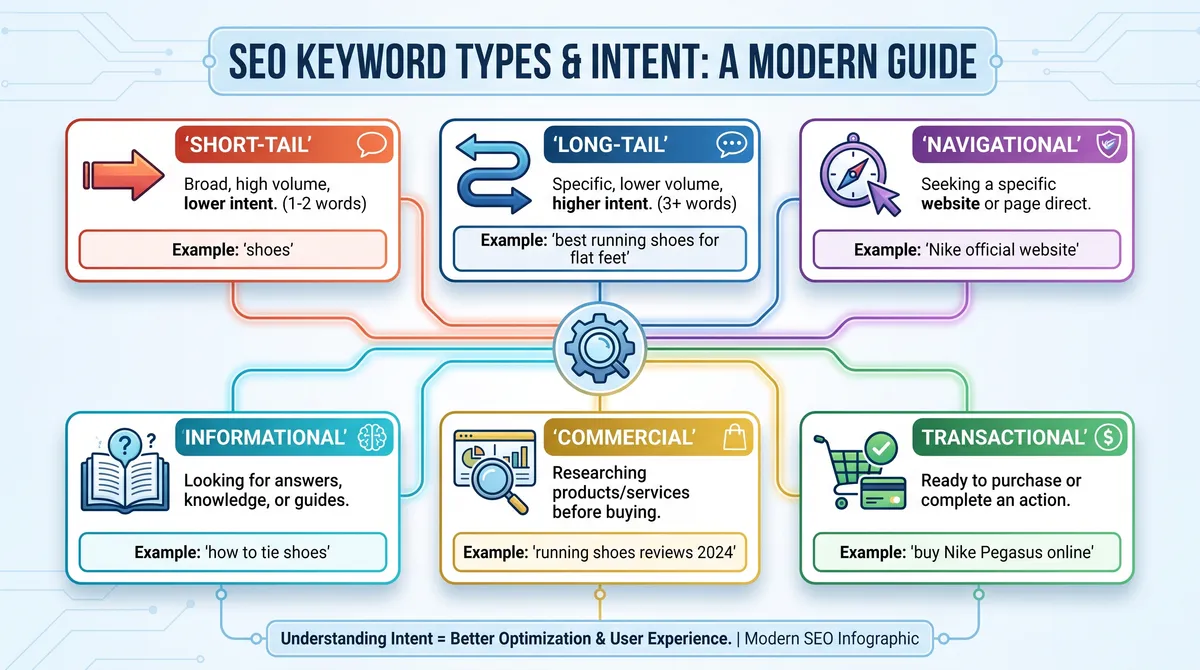
1. Short-Tail Keywords
Short-tail keywords are generally broad phrases consisting of a small number of words.
Examples:
- SEO
- laptops
- coffee
- digital marketing
- running shoes
They describe general subjects and can have multiple meanings.
2. Long-Tail Keywords
Long-tail keywords are more specific search queries, usually involving more than one word.
Examples:
- how to do keyword research for a new website
- best running shoes for beginners
- how to optimize a blog post for SEO
- affordable accounting software for small businesses
Long-tail searches can show a more specific user need.
3. Informational Keywords
Basically, these searches show that someone is looking for information.
Examples:
- what is keyword research
- how does SEO work
- how to write a meta description
- what is search intent?
4. Commercial Investigation Keywords
They often show that someone is researching options before deciding.
Examples:
- best SEO tools
- Ahrefs vs Semrush
- best email marketing software
- WordPress hosting reviews
5. Transactional Keywords
They show stronger intent to take action.
Examples:
- buy running shoes
- SEO software pricing
- website hosting discount
- purchase accounting software
6. Navigational Keywords
People usually use them to find a specific destination.
Examples:
- Google Search Console
- YouTube
- OpenAI ChatGPT
- Amazon login
The categories overlap, and a keyword can have more than one characteristic.
What Is Search Intent?#
Search intent is the reason someone searches.
Understanding the user's intent matters because the type of content needed can vary widely depending on what the user is looking for.
Consider the keyword:
“keyword research”
Someone searching this phrase could want:
- A definition
- A tutorial
- Keyword research tools
- A professional service
- A template
- A course
Now compare it with:
“how to do keyword research”
The phrasing clearly indicates this is a tutorial or step-by-step guide.
And:
“keyword research tools”
It therefore suggests the person searching might be looking for a comparison or a list of tools.
Before you select a keyword, examine the kind of content that would truly meet the searcher's needs.
Don't make a product page answer an informational question just because the keyword is valuable.
What Is Keyword Research?#
Keyword research involves finding, examining, sorting, and ranking the search terms relevant to your audience and business.
Effective keyword research answers questions such as:
- What is my audience islooking for?
- What problems are they attempting to solve?
- Which language do they speak?
- What questions do they ask?
- What kind of content should I produce?
- Which topics belong together?
- What search queries are relevant to my business?
- What keywords should have their own pages?
Keyword research should, in the end, aid you in developing a content strategy, not merely result in a spreadsheet containing various phrases.
How to Do Keyword Research Step by Step#
Step 1: Define Your Topic
Begin with the person you are writing about rather than using a keyword tool.
For example, if your website is about SEO, your broad topic might be:
SEO for beginners
From there, brainstorm related subjects:
- SEO basics
- keyword research
- on-page SEO
- technical SEO
- link building
- SEO tools
- local SEO
- content optimization
This gives you a universe of starting keywords.
Step 2: Create Seed Keywords
Seed keywords are general phrases that you can use to come up with more specific ideas.
For an SEO website, seed keywords could include:
- SEO
- keyword research
- SEO tools
- technical SEO
- content SEO
- local SEO
Don't worry about finding the exact keyword at this stage.
The aim is to create opportunities.
Step 3: Expand Your Keyword List
Find different versions using a range of sources.
Useful sources include:
- Google Search suggestions
- Related searches
- Google Trends
- Google Search Console
- Competitor content
- Customer questions
- Forums and communities
- Keyword research platforms
- Your own website analytics
Google Trends helps you compare search terms and track interest over time; it also separates specific search terms from broader topics, which can lead to different insights.
Step 4: Study Search Intent
For each promising keyword, ask:
What would a truly helpful result look like?
Classify the keyword as primarily:
- Informational
- Commercial investigation
- Transactional
- Navigational
Now look at the real search results.
Look for patterns.
Since most results are guides, a guide would be suitable.
Since most results are product pages, an informational article will not meet the searcher's needs.
Step 5: Group Similar Keywords
Rather than creating a separate page for each variation, group closely related searches, since the same resource can answer them.
For example:
- what are SEO keywords
- what are keywords in SEO?
- SEO keyword meaning
- keywords SEO definition
You can easily arrange them on a single comprehensive page.
On the other hand, these might require separate content:
- what are keywords in SEO
- best keyword research tools
- how to do keyword research
- keyword research services
The right structure will vary based on intent and how much information you need.
Step 6: Evaluate Business Relevance
A keyword might have high search interest and yet still be a bad one to target for your business.
Ask:
- Is this audience relevant?
- Can my website actually answer the question?
- Is the subject connected with my products or services?
- Would it be reasonable for the visitor to become a customer?
- Does the keyword align with my website's overall purpose?
Prioritize relevance over vanity metrics.
Step 7: Check Search Volume Carefully
Search volume estimates can help with prioritization, but they shouldn't be treated as a guarantee of traffic.
A keyword with lower volume can be valuable if the audience is highly relevant.
For instance, a specialized B2B query may receive fewer searches than a general consumer phrase yet be far more commercially relevant to a specific company.
Step 8: Evaluate Competition
Review the pages currently ranking.
Consider:
- Content depth
- Search intent
- Topical coverage
- Page quality
- Original information
- Website relevance
- User experience
- Freshness where freshness matters
It would be wrong to think a keyword is impossible just because large websites rank for it.
Rather, determine if you can come up with something that is both highly useful and distinct.
Step 9: Assign Keywords to Pages
Create a content map.
For example:
| | | | | --- | --- | --- | | Keyword research | keyword types, search intent | Keyword Research Guide | | On-page SEO | title tags, headings, internal links | On-Page SEO Guide | | Technical SEO | crawling, indexing, site structure | Technical SEO Guide | | Local SEO | Google Business Profile, local content | Local SEO Guide |
It stops the generation of random content and helps your website establish well-defined topical coverage.
Step 10: Create and Optimize the Content
After you understand the keyword and the user's intent, create the most suitable page for the user.
Use the primary topic naturally in relevant areas such as:
- Page title
- H1
- Introduction
- Relevant subheadings
- Body content
- Internal-link context
- Image alt text when genuinely descriptive
Google's advice suggests using descriptive language but cautions against keyword stuffing.
How to Choose the Right Keywords#
A useful keyword selection framework is:
Relevance + Intent + Opportunity + Business Value
Relevance
Is the keyword relevant to your subject?
Intent
Will the page you have planned be able to achieve the searcher's objective?
Opportunity
Is it really possible to produce a useful page that can compete for this query?
Business Value
Does your organization care about the audience?
This framework is more useful than simply listing keywords by search volume.
Just because many people search for a keyword doesn't mean it is valuable.
Keyword Difficulty and Competition#
Keyword difficulty is a measure provided by various SEO tools to estimate how hard it might be to achieve a position in search results for a particular search term.
Different platforms calculate difficulty differently.
So, treat keyword difficulty as a relative estimate, not an absolute probability of ranking.
For a more thorough evaluation, check the search results yourself.
Ask:
- Do the current pages actually answer the question?
- Is there an obvious lack of content?
- Is the intent clear?
- Can you give more helpful information?
- Can you give your own examples, data, experience, or thoughts?
- Does the reason for your website covering the topic make sense?
A qualitative review can identify opportunities that a single numerical difficulty score cannot.
Search Volume: What It Really Means#
Search volume estimates how many times a keyword is searched during a given period, based on the tool and method used.
It does not mean:
- You'll get that number of visitors.
- You will be ranked for that keyword.
- All searchers have the same intention.
- The keyword will attract customers.
- Search volume will stay the same.
Search behavior can vary with seasons, news, product launches, trends, language, geography, and other factors.
Google Trends can show relative interest and compare different search terms over specific periods.
For evergreen SEO, focus on topics that remain useful over time, and update pages when facts, products, tools, or recommendations genuinely change.
How to Use Keywords in Content#
Write naturally when covering the subject.
Include keywords when they help readers understand what the page is about.
Good locations can include:
- Title
- H1
- Relevant H2 or H3 headings
- Introduction
- Body copy
- Image alt text when appropriate
- Internal-link anchor text where natural
- URLs when descriptive and useful
You don’t have to use the exact keyword all over the page.
Google makes it clear that engaging in keyword stuffing violates its spam policies.
For example, avoid writing:
"SEO keywords matter because they help you rank for those keywords in search results.
Instead, explain the topic naturally:
"Keywords help you understand how your audience searches for information, and you can use that understanding to guide your content structure, page topics, and optimization decisions.
The second option includes more information without repeating it.
Keyword Clusters and Related Topics#
A keyword cluster consists of several closely related search terms and subtopics that you can cover as part of a broader content strategy.
For example, a website targeting keyword research might cover:
- keyword research
- keyword research tools
- long-tail keywords
- search intent
- keyword difficulty
- search volume
- competitor keyword research
- keyword mapping
- keyword clustering
- content gaps
They can assist each other via a logical internal-link structure.
We're not aiming to produce dozens of pages that are almost identical.
Google cautions against producing large amounts of content to manipulate Search or generative AI systems.
Create pages only when users genuinely need them.
Common Keyword Research Mistakes#
1. Selecting keywords solely based on search volume
High volume doesn't necessarily mean high value.
2. Ignoring Search Intent
A page might use the correct words and yet still fail to satisfy the user.
3. Using exact-match keywords everywhere
Natural language is more practical than repeated phrasing.
4. Preparing one page for each small variation
One comprehensive resource can often cover closely related queries.
5. Ignoring Business Relevance
Traffic that has no connection with your audience may have little business value.
6. Copying Competitors
While competitor research can show you what topics to cover, your page should still offer its own value.
Google promotes original, useful content rather than re-producing or re-writing what is already available.
7. Regarding Keyword Tools as absolute truth
Tool metrics are only estimates; you should combine them with an analysis of the search results and your knowledge of the audience.
8. Forgetting Existing Data
The queries for which your own pages appear can be found in your Search Console data.
Google's Performance report lets site owners look at queries, pages, clicks, impressions, CTR, and average position.
How to Measure Keyword Performance#
Once you publish content, keep an eye on what happens.
Google Search Console can show:
- Queries
- Clicks
- Impressions
- CTR
- Average position
- Pages
- Countries
- Devices
The performance report helps you see which queries bring users to your site and identify opportunities to improve your current content.
Look for patterns such as:
High impressions + low CTR
The page is showing up but might not be getting sufficient clicks. Check the title, description, intent alignment, and how it appears in search results.
Increasing impressions + few clicks
While the page may be becoming more visible relative to other searches, it might need to improve its relevance or present better results.
Clicks from unexpected queries
They can show your audience new topics that are associated with your content.
Declining impressions
Find out if there has been a change in search demand, competition, content relevance, seasonality, or the search landscape.
Google also advises paying attention to trends in impressions and clicks rather than relying solely on average position.
A Simple Keyword Research Workflow#
You can turn the whole process into a repeatable workflow.
Phase 1: Discover
Start with:
- Business topics
- Customer questions
- Seed keywords
- Search suggestions
- Competitor content
- Search Console data
- Trends
Phase 2: Analyze
For each keyword, determine:
- Search intent
- Relevance
- Topic
- Competition
- Potential business value
- Content type
Phase 3: Organize
Group related keywords into:
- Individual pages
- Topic clusters
- Supporting articles
- Product or service pages
- FAQ sections
Phase 4: Create
Build content that:
- Answers the primary question
- Covers important subtopics
- Uses natural language
- Provides original value
- Links to relevant pages
- Makes the next step clear
Phase 5: Measure
After publication:
- Check Search Console.
- Review impressions.
- Review clicks.
- Examine queries.
- Check CTR.
- Identify new related searches.
- Make the page better if it's useful.
This turns keyword research into an ongoing SEO process rather than a one-off activity.
FAQs About SEO Keywords
What are keywords in the context of SEO?#
Keywords are the words and phrases people use when searching for information with search engines, and SEO specialists conduct keyword research to understand these searches and produce content that meets users' needs.
2. What is the importance of keywords in SEO?#
Website owners can use keywords to understand what their audience is searching for. Keywords help determine content topics, page structure, internal links, and the overall SEO strategy.
What is keyword research?#
Keyword research involves finding and examining relevant search terms, understanding what purpose they serve, assessing their usefulness, and organizing them into a content strategy.
What are long-tail keywords?#
Long-tail keywords are usually more specific search expressions, for example, 'best running shoes for beginner runners'. They usually indicate a more detailed need than general terms like 'running shoes'.
How many keywords should be used on a page?#
There isn't a general ideal number of keywords. It's better to discuss the subject naturally and thoroughly than to aim for a specific keyword density. Google itself cautions against overusing keywords.
Is it good for SEO to stuff keywords?#
That is, inserting keywords too frequently to influence search rankings is known as keyword stuffing, and Google considers it a spamming practice.
7. Does a high search volume always indicate something better?#
Not at all; a high-volume keyword may be too broad, extremely competitive, or not well matched to your audience. In some cases, a more specific keyword can be more relevant to the searcher's needs.
What does search intent mean?#
Search intent is the reason behind a search. Common categories include informational, commercial investigation, transactional, and navigational intent.
9. Should every keyword have its own page?#
No. Closely related keywords can often be covered effectively on one comprehensive page. Creating unnecessary pages for minor variations can produce a poor website structure and may add little value.
10. Can I use AI to help with keyword research?#
AI can help brainstorm topics, categorize keywords, identify questions, and organize research. However, the resulting content should still be useful, accurate, original, and written for people. Google's current guidance emphasizes valuable, people-first content and warns against scaled content created primarily to manipulate search visibility.
Conclusion
Keywords remain an important part of SEO because they reveal what people are looking for and the language they use to describe their needs.
But modern keyword research is much more than collecting popular phrases.
A strong process combines search intent, relevance, topic coverage, audience needs, competition, business value, and real performance data.
Start with your audience. Find the questions and problems they care about. Research the language they use. Group related topics logically. Then create content that provides a complete and satisfying answer.
Most importantly, avoid turning SEO into a keyword-placement exercise.
Google's guidance consistently emphasizes helpful, reliable, people-first content. Its documentation also makes clear that no secret formula automatically puts a page first in Search.
The most durable keyword strategy is therefore not:
“How many times can I use this keyword?”
It is:
“What does the person searching this topic need, and how can my page help them better?”
That mindset makes keyword research useful not only for Google Search, but also for building a clearer, more helpful website for real people.