How to Do Keyword Research for SEO: Step-by-Step
Learn how to do keyword research for SEO with this step-by-step guide. Discover keywords, analyze search intent, evaluate competition, and build a winning strategy.

Introduction
Keyword research is a fundamental part of SEO. It's the process of figuring out what people are searching for online, what they need, and what topics your site should cover.
To do keyword research for SEO, start by identifying your audience and topics. Generate keyword ideas using a range of research tools, assess search intent, review search volume and competition, analyze competitors, and then group your keywords into clusters. Once you've done that, you can assign each of the keyword clusters to the appropriate page on your site.
Whether you're running a personal blog, an eCommerce site, or a business website, understanding keyword research can go a long way toward producing content that attracts relevant organic traffic.
In this guide, you'll learn exactly how to do keyword research step by step, what tools to use, how to assess keyword opportunities, and how to turn that research into an actual SEO strategy.
What Is Keyword Research?#
Keyword research is the process of identifying and analyzing the search terms people use in search engines (e.g., Google, Bing).
These are the search terms (commonly referred to as keywords or search queries).
For example, someone interested in improving website performance might search for:
- How to improve website speed
- Best website optimization tools
- Website performance testing
- How to reduce page loading time
Each search query is a potential content opportunity.
Keyword research helps website owners understand:
- What their target audience is actually searching for.
- Which topics have genuine search demand?
- How competitive particular search terms are.
- What kind of content do users expect to see?
- Which topics provide the most business value?
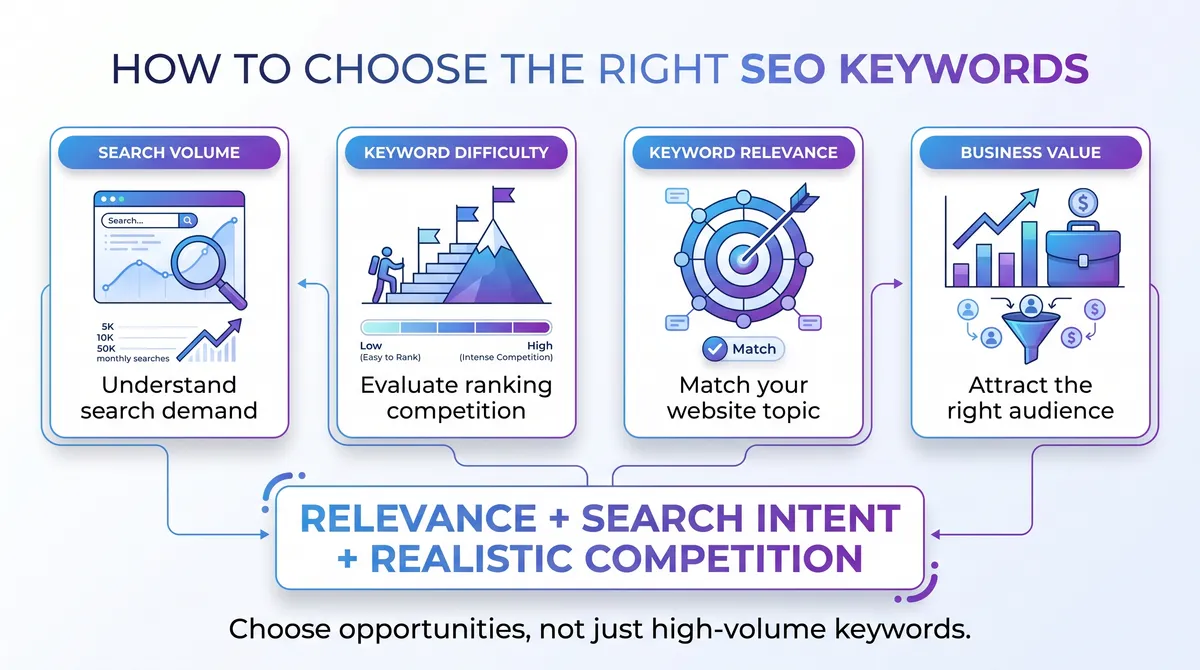
The aim isn't just to grab the keywords with the highest search volumes. It's about finding the search queries that are relevant to your audience and to your site.
Why Is Keyword Research Important for SEO?#
Publishing content without any keyword research is like opening a shop without knowing what your customers want. You could have the best products in the world, but it's going to be very difficult to get the right people in.
Keyword research helps you make your content decisions.
- Discover what your audience wants
Understanding the search queries will go a long potential visitors' to helping you to identify the quend the interests of your potential visitors.
- Find content opportunities
Keyword research will reveal topics your competitors may have missed completely (e.g., specific long-tail searches, unanswered questions, etc.).
- Improve search visibility
Targeting the right search terms helps search engines understand what your pages are about and link them to the right searches.
- Understand search intent
Different keywords represent different stages in the customer journey. Research will help you create the appropriate type of content for each stage.
- Build topical authority
Organize your related keywords into topic clusters to achieve proper coverage of the key subjects within your niche.
- Attract relevant visitors
A lower-volume keyword can bring you more valuable visitors than a broad, highly competitive one.
Ultimately, effective keyword research helps you write content for people rather than publish articles to increase your page count.
Understanding Different Types of Keywords#
Before you start your research, learn the main keyword categories.
1. Short-Tail Keywords
Short-tail keywords are broad search terms, generally consisting of one or two words.
Examples:
- SEO
- Digital marketing
- Web hosting
- Keyword research
These keywords will generally have broad search intent and are likely to be very competitive.
They may generate a lot of search volume, but it can be tricky to determine exactly what the searcher is looking for.
2. Long-Tail Keywords
Long-tail keywords are more specific search phrases (i.e., multi-word phrases).
Examples:
- How to do keyword research for a new website
- Best free SEO tools for small businesses
- How to improve WordPress website speed
Long-tail keywords tend to have more specific intent and can be more realistic opportunities for a new site.
They may have lower individual search volumes but can attract visitors who know exactly what information they're looking for.
3. Branded and Non-Branded Keywords
Branded keywords include a specific company, product, or brand name.
Examples:
- Ahrefs keyword research
- Semrush pricing
- Google Search Console
Non-branded keywords don't contain a specific brand.
Examples:
- Best keyword research tools
- How to improve website rankings
- SEO tips for beginners
Both of those categories can be useful, of course, depending on what you're trying to achieve with your site.
Step-by-Step: How to Do Keyword Research for SEO#
Here's a practical keyword research workflow you can follow for pretty much any site.
Step 1: Define Your Target Audience and SEO Goals
Start by working out who you want to attract.
Before opening any keyword research tool, answer these questions:
- Who is your target audience?
- What problems are they actually trying to solve?
- What are they looking for?
- What products and services do you provide?
- What are the topics that are relevant to your site?
For example, imagine you run a website that publishes SEO tutorials.
Your potential audience might include:
- Beginner bloggers
- Small business owners
- SEO professionals
- Affiliate marketers
- Website developers
Each audience segment has different search interests.
A novice might be looking for 'what is SEO,' whereas a more experienced marketer is likely searching for 'technical SEO audit checklist.'
Defining your audience helps you find keywords relevant to your site, rather than just gathering random search terms.
Step 2: Find Your Seed Keywords
Seed keywords are broad terms that describe your site, your business, your products, or indeed your main topic.
They serve as a starting point for finding additional keyword ideas.
For an SEO website, possible seed keywords include:
| SEO Basics | SEO, search engine optimization |
| Keyword Research | Keywords, keyword analysis |
| Link Building | Backlinks, link building |
| Technical SEO | Website crawling, indexing |
| Content Marketing | SEO content, blog writing |
| Website Performance | Page speed, Core Web Vitals |
Start with around 5 to 15 relevant seed topics.
Think about how your potential visitors would describe their problems. Their language is probably more useful than any industry terminology.
Step 3: Expand Your Keyword List
Once you've got your seed keywords, you then want to expand those out into more specific search queries.
You can use keyword research tools, Google Autocomplete, related searches, and questions that appear in search results.
For example, start with the seed keyword:
Keyword research
You might discover related searches such as:
- How to do keyword research
- Free keyword research tools
- Keyword research for beginners
- How to find low-competition keywords
- Keyword research for YouTube
- How to find long-tail keywords
- Keyword research for local SEO
You can also explore question-based searches:
- What is keyword research?
- Why is keyword research important?
- How many keywords should you be targeting?
- How do I go about finding profitable keywords?
Collect those ideas into a spreadsheet.
At this stage, focus on finding relevant opportunities rather than removing every keyword with low search volume.
Step 4: Analyze Search Intent
Search intent is the reason for the search.
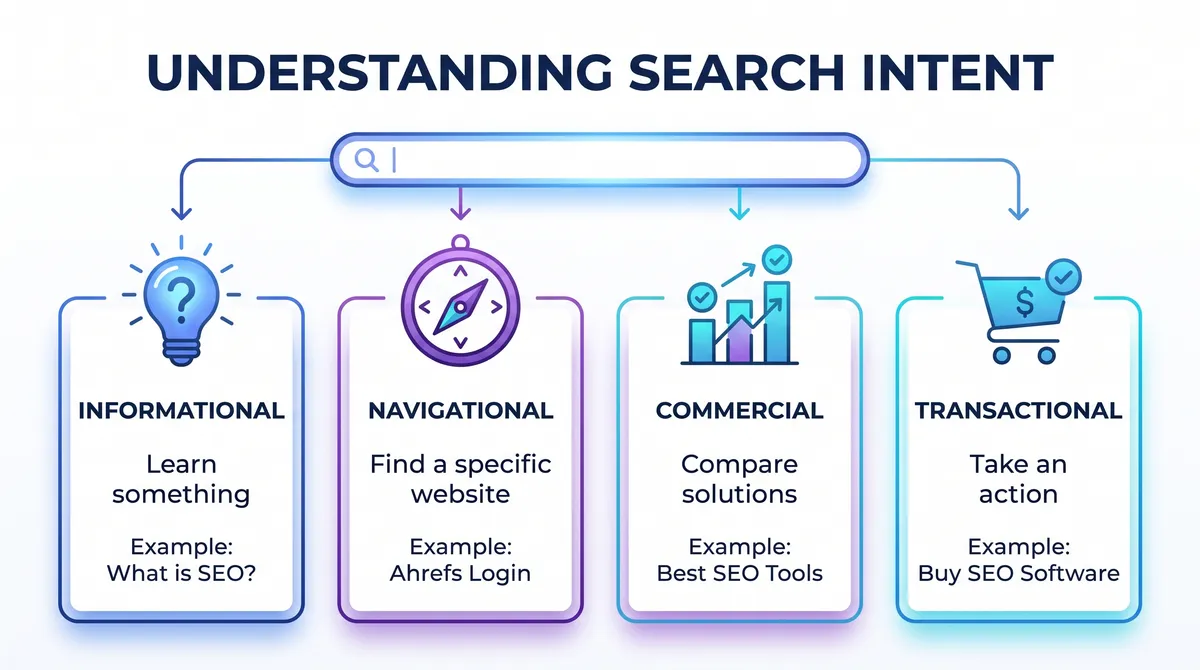
Understanding search intent is vital, as different searches require different types of content.
There are four broadly used categories.
| Informational | Learn something | What is keyword research? |
| Navigational | Find a specific website | Ahrefs login |
| Commercial | Compare available options | Best keyword research tools |
| Transactional | Complete an action | Buy SEO software |
Consider these two searches:
- "What is keyword research?"
- "Best keyword research software"
Although both are about keyword research, they're for entirely different purposes.
The first one's an educational article. The second one is more like a comparison or a review.
How do you work out search intent?
Search the keyword on Google and look at the first page.
Look at:
- The types of pages that are ranking in the results.
- Whether the results are blog posts, product pages, or landing pages.
- The questions and topics addressed by the competing pages.
- The content formats that Google seems to favor.
Don't assume that a keyword needs a blog post simply because you want to write one.
Your content format should be what searchers actually expect.
Step 5: Evaluate Keyword Metrics
Once you've got your list of keyword ideas, assess their potential using a range of SEO metrics.
The most useful metrics include:
Search Volume
Search volume is an estimate of how often a keyword is searched over a given period of time (usually per month).
Higher search volume can indicate greater demand, but that doesn't necessarily make the keyword valuable.
Keyword Difficulty
Keyword difficulty (KD) measures how hard it might be to rank for a particular keyword.
Different SEO tools will calculate that metric in different ways.
Use it as a comparative indicator rather than a guarantee of ranking difficulty.
Cost Per Click (CPC)
CPC is the estimated cost to the advertiser of a click on a paid search ad.
It can indicate commercial intent, though a high CPC doesn't necessarily mean the keyword is one you'd want on your site.
Traffic Potential
Traffic potential estimates how much organic traffic a page might get by ranking for its main keyword and associated search queries.
A page can rank for many relevant keywords, so looking at the search volume of just one phrase can be misleading.
Keyword Relevance
Relevance is undoubtedly one of the most important factors.
A keyword may have fantastic search volume and low competition, but if it has nothing to do with your site, targeting it won't achieve anything.
Here is a simple comparison:
| SEO | High | High | High |
| Keyword research for beginners | Medium | Medium | High |
| Free keyword research tools | Medium | Medium | High |
| Best gaming laptops | High | High | Low |
Illustrative comparison only. These are not live keyword metrics.
For most new sites, it makes more sense to focus on relevant, attainable keywords than to go after the biggest search volumes.
Step 6: Analyze Your Competitors
Competitor research helps you find keywords that are already driving visibility for sites in your niche.
Identify circa 3 to 5 relevant competitors.
Then investigate:
- Which keywords are bringing organic traffic to their sites?
- Which articles get the best search visibility?
- What topics do they cover regularly?
- Which keywords have fairly low competition?
- Are there any important questions that their content doesn't actually answer?
Tools such as Ahrefs and Semrush can do competitor keyword analysis.
You can also do manual research by searching your target keywords on Google.
Pay attention to:
- Content depth
- Page structure
- Search intent
- Supporting topics
- Content freshness
- Internal linking
Don't just rehash competitor articles.
Instead, identify information gaps and produce something more useful, accurate, and comprehensive.
Step 7: Group Related Keywords Into Clusters
Keyword clustering groups similar keywords by meaning and intent.
This helps you avoid publishing multiple articles for nearly identical searches.
For example:
Main topic: Keyword Research
Primary keyword
how to do keyword research for SEO
Related keywords
- SEO keyword research guide
- keyword research step by step
- keyword research for beginners
- how to find SEO keywords
- keyword analysis process
One comprehensive article
You can cover all closely related keywords in the same guide, since they share the same search intent.
However, not every similar-looking keyword should be on the same page.
Compare their Google results for the queries in question before merging them. If different pages consistently rank for the two queries, they probably warrant separate content.
Proper keyword clustering helps structure your site and reduce redundant content.
Step 8: Create a Keyword Mapping Strategy
Keyword mapping is the process of assigning keyword groups to individual web pages.
Each important keyword cluster should have a clearly defined target URL.
For example:
| SEO Basics Guide | What is SEO | SEO basics, SEO explained |
| Keyword Research Guide | How to do keyword research | SEO keyword research, keyword analysis |
| Link Building Guide | What is link building | backlinks, link building strategies |
| Technical SEO Guide | Technical SEO checklist | website crawling, indexing |
This structure enables you to build a logical content strategy.
It also reduces keyword cannibalization (when multiple pages compete for the same or very similar search queries).
Before you go and write a new article, check whether you already have a page on that topic.
Sometimes it's more effective to update an existing page than to publish a similar new one.
Step 9: Prioritize Keywords and Build Your Content Calendar
Your research should ultimately become an actionable publishing plan.
Not every keyword is worth looking at immediately.
Prioritize opportunities using:
- Relevance to your website
- Search intent
- Search demand
- Ranking competition
- Business value
- Existing topical coverage
- Content creation resources
For a fairly new site, a sensible approach is to build supporting content around a specific topic before you start targeting the really competitive broad keywords.
For example, an SEO website might start with:
- What Is SEO? A Complete Beginner's Guide
- How to Do Keyword Research for SEO
- What Are Long-Tail Keywords?
- How to Find Low-Competition Keywords
- What is search intent in SEO?
- Best Free Keyword Research Tools
These articles can, of course, support each other via appropriate internal links.
Organize the topics into a monthly content calendar so you can publish regularly and track your progress.
Best Keyword Research Tools#
Choosing the right tools will make keyword research faster and more structured.
You don't need an expensive subscription to get going. Several useful tools are available for free.
Tool features and subscription limits are subject to change. Always check the official product pages for the most up-to-date information.
| Google Keyword Planner | Keyword ideas and advertising search estimates | Free |
| Google Search Console | Existing search queries and performance | Free |
| Google Trends | Search interest and seasonality | Free |
| Ahrefs | Keyword and competitor research | Free and paid features |
| Semrush | Keyword analysis and competitor research | Free and paid features |
| Ubersuggest | Keyword ideas and SEO analysis | Free and paid features |
| AnswerThePublic | Question-based keyword ideas | Free and paid features |
1. Google Keyword Planner
Google Keyword Planner helps you find keyword ideas and see estimated search volume.
It's very useful for finding related search terms and for exploring keyword opportunities.
Official site: Google Keyword Planner.
2. Google Search Console
Google Search Console is one of the most useful free tools for researching the keywords your site already appears for.
Its Performance report provides information about:
- Search queries
- Impressions
- Clicks
- Click-through rate
- Average position
You can identify queries where your site gets impressions but could use better content or page optimization.
Official website: Google Search Console.
3. Ahrefs
Ahrefs has keyword discovery, keyword difficulty estimates, competitor analysis, and related keyword research.
It's extremely useful when you're going out and researching competitor sites to find keyword opportunities.
Official website: Ahrefs.
4. Semrush
Semrush provides keyword research, competitor analysis, keyword grouping, and broader SEO research.
Its Keyword Magic tool lets you take a seed keyword and expand it into more specific search queries.
Official website: Semrush.
Common Keyword Research Mistakes to Avoid#
Even seasoned website owners can make mistakes when picking keywords.
Here are some of the common problems to avoid.
- Targeting only high-volume keywords
High search volume doesn't necessarily translate into valuable traffic. You've got to be looking at relevance and realistic opportunities for ranking.
- Ignoring search intent
Creating an informational article for a keyword that is dominated by product pages is likely to be of little or no use to the searcher.
- Overusing keywords
Repeating the same keyword throughout an article is just plain hard to read. Use related phrases naturally.
- Ignoring long-tail keywords
Specific search queries can be a goldmine, particularly for a new site.
- Creating multiple pages for similar keywords
Publishing several very similar articles can create unnecessary competition between your own pages.
- Never updating keyword research
Search behavior, competition, and trends all change. You need to review your keyword strategy regularly.
- Choosing keywords without considering business value
A keyword should serve the purpose of your site. Traffic that is irrelevant to your audience or your objectives is unlikely to be of any real benefit.
How Is Keyword Research Changing With AI Search?#
Search engines are changing, and people are increasingly using AI-powered platforms to find information.
Traditional keyword research is still important, but you also need to consider how people phrase their questions in conversational searches.
For example, a traditional search might be:
"Best keyword research tools"
A more conversational query might be:
'Which keyword research tool is best for a beginner starting a new blog on a tight budget?'
This opens the door to going into detail, making comparisons, and addressing follow-up questions.
Consider these practices:
- Include useful question-based headings.
- Answer important questions directly.
- Explain the concepts with practical examples.
- Cover related topics comprehensively.
- Use clear headings and descriptive terminology.
- Support factual claims with reliable sources.
- Keep the information accurate and up to date.
You can also review relevant questions asked on community sites and see how AI search tools respond to topics in your area.
There's no guaranteed keyword formula for getting into AI-generated answers. The best approach is to produce genuinely useful, reliable, and accessible content.
5. Frequently Asked Questions#
1. What is the best way to do keyword research for SEO?
The best way is to identify your audience, come up with seed keywords, expand them using a keyword tool, determine the search intent behind them, assess competition, group the keywords, and assign clusters to the appropriate pages.
2. Can I do keyword research for free?
Yes, you can do useful keyword research with Google Keyword Planner, Google Search Console, Google Trends, Google Autocomplete, and manual Google searches. Paid tools can provide more competitor data and research.
3. How many keywords should I be targeting per article?
There is no fixed number. Start with one primary keyword and then work in your relevant secondary keywords and related questions as and when they fit naturally with the topic. The aim should be to satisfy search intent rather than hit a specific keyword count.
4. What constitutes a good keyword search volume?
There is no universal ideal search volume. A keyword with 100 searches a month could be far more valuable to a very niche site than one with 10,000 searches, because it targets a much more relevant audience.
5. Are long-tail keywords better for new sites?
Long-tail keywords can be very useful for a new site because they tend to have more specific search intent and are likely less competitive. Of course, every keyword should be evaluated on its own merits.
6. What is keyword difficulty in SEO?
Keyword difficulty is a metric used by various SEO tools to indicate how hard it might be to rank for a particular keyword. Different tools calculate it differently, so treat it as an estimate, not a prediction of whether you'll actually rank.
7. How often should you do keyword research?
Do keyword research when you're planning new content, when you're branching out into a new topic, or when you're reviewing your overall SEO strategy. It's also worth reviewing the performance of your existing keywords quarterly to see what new opportunities may have arisen.
8. What is keyword clustering?
Keyword clustering is the process of grouping search queries with similar search intent. It's a way of working out which keywords you should target on the same page and which ones you should actually have separate articles for.
9. Does keyword research help with AI search visibility?
Yes, keyword research helps you understand what questions and topics people care about. That, in turn, can help you produce content that is useful for both traditional search and AI search. Keyword optimization in itself won't get you AI citations or visibility.
10. Should I be looking at keyword volume or keyword difficulty?
Consider both in terms of relevance, search intent, traffic potential, and business value. A very relevant keyword with attainable competition is often a far better opportunity than a very popular keyword your site can't satisfy.
Conclusion#
Keyword research is much more than finding popular search terms. It's about understanding your audience, finding the real search opportunities, and then creating content that actually answers their questions.
With a proper keyword research process, you can identify relevant keywords, determine search intent, assess competition, build topic clusters, and create a practical content strategy.
Start with a small group of relevant topics, explore keyword opportunities using free tools, and gradually build your website's coverage around subjects that matter to your audience.
Remember: The best keyword is not necessarily the one with the highest search volume. It is the one that connects the right audience with the right content.