Keyword Difficulty Explained: How Hard Is It to Rank for a Keyword?
Understand what keyword difficulty means in SEO, how tools calculate 0–100 KD scores, and how to analyze live SERP competition to uncover realistic ranking wins.
Finding keywords people actually search for is only half the work in search engine optimization. Before investing hours into writing or optimizing a page, you also need to gauge how tough the competition already ranking for that query is.
That is where keyword difficulty (KD) comes in. Keyword difficulty is an SEO metric that estimates how challenging it will be to earn a top organic ranking for a specific search term. Ranking for a broad term like "SEO," for example, demands vastly more authority and effort than ranking for a focused query like "SEO tips for small business websites."
Still, a low keyword difficulty score never guarantees an effortless win—just as a moderate score does not mean a topic is out of reach. In this guide, you will learn what keyword difficulty means, how SEO tools calculate KD scores, how to audit live SERP competition yourself, and how to uncover realistic ranking opportunities.
What Is Keyword Difficulty in SEO?#
Keyword difficulty is an estimated score used by SEO research platforms to measure how hard it is to rank organically on the first page of search results for a given query.
Most platforms display KD on a 0 to 100 scale, where higher numbers represent stronger competition and lower numbers point to fewer or weaker competing pages:
| Keyword | Illustrative KD Score | Competition Level |
|---|---|---|
| SEO | 95 | Very High |
| Keyword Research | 75 | High |
| Keyword Mapping Guide | 38 | Moderate |
| SEO Keywords for Small Blogs | 18 | Low |
| How to Find Keywords for a New Website | 12 | Very Low |
Note: These scores are illustrative examples rather than live measurements. Actual numbers vary across tools and shift as search results change.
At its core, keyword difficulty answers one practical question: how strong is the competition my page must outperform to reach page one?
Crucially, keyword difficulty is not an official Google ranking factor. Google does not publish or assign public KD scores to search queries. Third-party SEO platforms calculate their own estimates using independent backlink indexes, SERP snapshots, and proprietary models—so treat KD as a helpful screening indicator, never a promise.
Understanding Keyword Difficulty Scores#
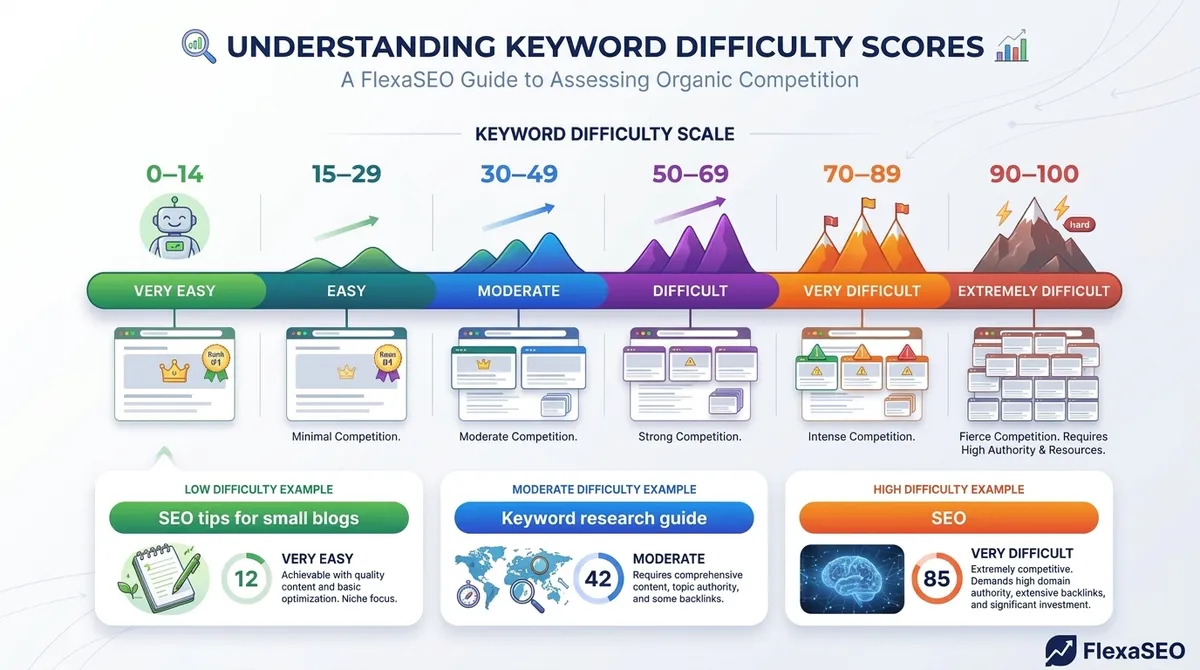
Although each SEO tool uses a slightly different formula, a 0–100 scale gives a practical framework for sorting raw keyword lists before checking individual search results.
| KD Score | Difficulty Tier | General SEO Guidance |
|---|---|---|
| 0–14 | Very Easy | Strong starting targets for new or smaller sites |
| 15–29 | Easy | Attainable with clear intent alignment and quality depth |
| 30–49 | Moderate | Requires thorough coverage, structure, and supporting links |
| 50–69 | Difficult | Features established websites and stronger link profiles |
| 70–89 | Very Difficult | Dominated by authoritative brands and deep content hubs |
| 90–100 | Extremely Difficult | Fiercely competitive head terms requiring long-term authority |
Very Easy Keywords (0–14)
Keywords in the 0–14 range generally face light link competition and fewer dedicated, comprehensive answers. They are especially valuable for new websites, focused niche blogs, local service businesses, and sites still building domain authority—such as targeting "digital marketing checklist for local businesses" instead of "digital marketing."
Easy Keywords (15–29)
Easy keywords offer realistic opportunities once your site has started building topical coverage. More relevant pages may already compete here, yet a crisp, well-structured guide tailored tightly to search intent can still break into the top ten.
Moderate Keywords (30–49)
Ranking in the 30–49 tier typically demands stronger execution: thorough topic depth, clean internal linking from supporting articles, clear page hierarchy, and credible backlinks or brand signals.
Difficult Keywords (50–69)
At this level, established niche publications and recognized businesses occupy most top spots. Competing usually requires proven topical authority, standout editorial quality, and an earned backlink profile.
Very Difficult Keywords (70–89)
Queries scoring 70–89 are usually held by major brands, software leaders, and national media sites. Newer domains usually build faster momentum by covering closely related subtopics first and linking upward.
Extremely Difficult Keywords (90–100)
The highest tier covers broad, high-volume, or lucrative commercial terms. Chasing these immediately rarely pays off for lean websites; use them to define top-level topic hubs while earning early wins on supporting queries underneath.
How SEO Tools Calculate Keyword Difficulty#
Every SEO platform weighs ranking signals differently, so the exact same keyword can show a KD of 22 in one dashboard and 48 in another. Still, most difficulty algorithms evaluate a similar set of competitive signals.
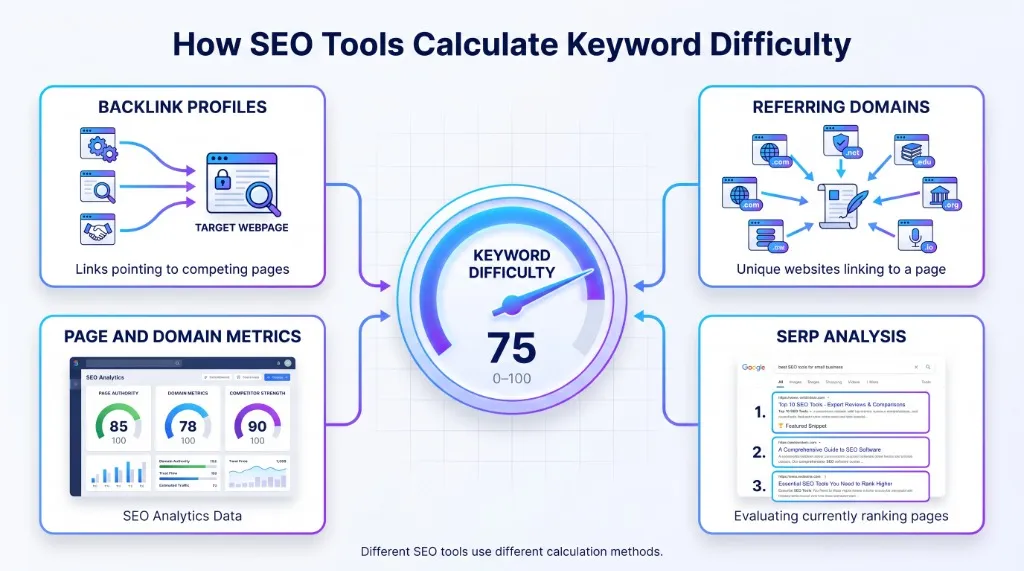
Backlink Profiles
Backlinks are links from external websites pointing to a ranking page. Tools examine both the quantity and perceived quality of backlinks earned by the current top 10 URLs, since pages supported by dozens of editorial links are generally harder to displace.
Referring Domains
A referring domain is a unique website linking to a page—if five different sites link to your guide once each, you have five referring domains. Many KD models rely heavily on median or average referring domains across page-one results because diverse external citations are harder to replicate than repeated links from one domain.
Page and Domain Authority Metrics
Platforms also factor in proprietary authority indicators such as Ahrefs Domain Rating (DR) and URL Rating (UR), Semrush Authority Score, or Moz Domain Authority (DA). These metrics help compare site strength side by side, though none of them are direct Google ranking signals.
Live Search Results Competition
Some tools inspect how closely top-ranking pages match the query, whether major publishers fill the top slots, or whether outdated and thin pages sit in the top ten.
SERP Features and Layout
Organic competition is also shaped by SERP layout elements—featured snippets, video carousels, shopping grids, local map packs, and People Also Ask boxes—which affect how many true organic clicks remain above the fold.
Important: Never rely on a single KD number in isolation. Always inspect the live Google results before committing a full article or landing page.
Keyword Difficulty vs. Paid Keyword Competition#
Beginners often confuse organic keyword difficulty with the "Competition" column inside Google Keyword Planner. Although the terms sound interchangeable, they measure completely different channels.
| Feature | Organic Keyword Difficulty | Paid Keyword Competition |
|---|---|---|
| Purpose | Estimates difficulty of ranking organically | Measures advertiser bidding density |
| Channel | Organic search (SEO) | Paid search ads (PPC) |
| Primary users | SEO teams, bloggers, content marketers | Paid search and performance advertisers |
| Typical values | 0–100 numerical score | Low, Medium, High (plus ad index) |
| Core signal | Competing pages, backlinks, SERP authority | Number of advertisers bidding on the term |
A query can have intense paid advertiser competition yet relatively mild organic competition, or heavy organic authority barriers with almost no active ad bidders. Keep the two metrics separate when planning content.
Top Tools to Check Keyword Difficulty#
You do not need an expensive software suite just to start assessing competition, though paid platforms speed up large-scale filtering.
Ahrefs
Ahrefs calculates Keyword Difficulty primarily from the number of referring domains pointing to top-10 ranking pages, alongside estimates of how many referring domains you may need to break into page one. It is especially helpful for comparing parent topics and inspecting backlink gaps directly.
Semrush
Semrush combines referring domain data, authority metrics, and SERP feature signals inside Keyword Overview and its Keyword Magic Tool. Its Personal Keyword Difficulty feature also helps gauge how realistic a query is relative to your own domain.
Moz Keyword Explorer
Moz calculates KD using Page Authority and Domain Authority across top-ranking results while factoring in organic click-through opportunity and SERP features.
Google Keyword Planner
Google Keyword Planner is built for Google Ads campaigns and provides search volume ranges, keyword suggestions, and advertiser bid data. Use it to brainstorm demand, but remember its competition rating reflects ad bidding rather than organic SEO difficulty.
Free Keyword Discovery Tools
You can also evaluate demand and competition using free tools like Google Autocomplete, Google Trends, Google Search Console, and free keyword research tiers. Even without a proprietary KD number, scanning live search results tells you a great deal about how approachable a query is.
How to Evaluate Keyword Difficulty Manually#
A 60-second manual SERP check prevents more wasted content than any metric in a spreadsheet. Walk through these six steps before finalizing a target keyword.
Step 1: Search Your Target Keyword
Open an incognito browser window and search the exact query in Google. Look at the full page-one layout, including ads, map packs, video blocks, and organic links.
Step 2: Analyze the Competing Domains
Ask whether page one is locked down by household brands, government portals, and industry giants, or whether independent blogs and smaller sites hold positions in the top ten. Seeing smaller, niche sites rank is an encouraging sign—provided their pages are not backed by massive niche link profiles.
Step 3: Evaluate Content Quality and Depth
Open the top three to five organic results and judge them honestly:
- Do they answer the exact question quickly and clearly?
- Is the advice accurate, practical, and up to date?
- Are examples, visuals, tables, or clear steps missing?
- Are searchers forced to wade through fluff before reaching the answer?
Outperforming a long, unfocused page is very achievable when your guide solves the problem cleanly.
Step 4: Inspect Competing Backlinks
If you have access to a backlink checker, check how many quality referring domains point specifically to those ranking URLs—not just their homepages. A high-authority domain ranking with zero page-level backlinks and an off-angle post is often surprisingly beatable.
Step 5: Verify Search Intent
Match your page format to what Google already rewards. Review the four core search intent types—informational, navigational, commercial, and transactional—and verify whether page one favors tutorials, comparison lists, tools, or product pages.
Step 6: Benchmark Against Your Own Website
Compare the ranking pages against your own site's topical coverage, internal link network, technical health, and backlink profile. The exact same keyword can be "easy" for an established SaaS blog yet "hard" for a brand-new site with five articles. Run your existing pages through our free SEO Analyzer to spot on-page and structural gaps before targeting tougher keywords.
Why Low Keyword Difficulty Does Not Guarantee Rankings#
Plenty of creators chase KD 0–10 terms only to see zero traffic months later. Low estimated difficulty falls short when one of five hidden blockers gets in the way:
Low Search Demand
An uncompetitive phrase that nobody actually searches may rank in position one within weeks yet bring only two visits a month.
Mismatched Search Intent
Targeting the right words in the wrong format—such as publishing a textbook definition where users want a software comparison—keeps a page off page one regardless of low backlink counts.
Strong Intent Satisfaction
Even if ranking pages have few backlinks, they may answer the user's question so cleanly that searchers rarely bounce back to click another result.
Weak Topical Relevance
A site covering unrelated random topics struggles to outrank specialized sites that demonstrate consistent expertise across a cohesive subject cluster.
Technical SEO Issues
Crawl blocks, slow loading speeds, poor mobile rendering, or broken internal navigation can hold back otherwise strong articles. Periodically inspect your site with tools like our Broken Link Checker and Page Speed Test so technical friction never undermines your content.
How to Find Low-Difficulty Keywords That Actually Rank#
Finding realistic wins means pairing tool filters with smart topic organization and business relevance.
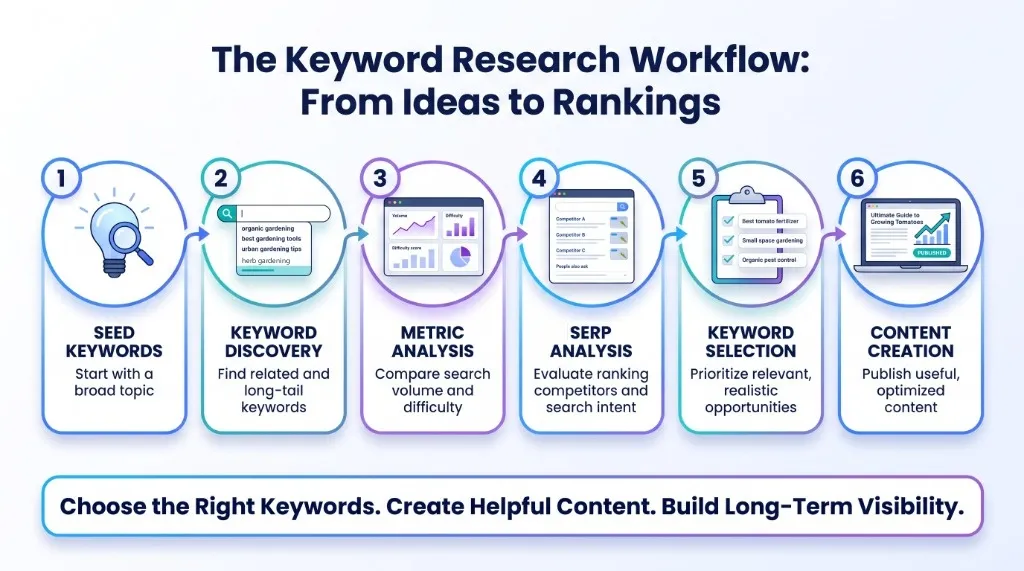
1. Start With a Broad Seed Topic
Begin with a core category tied to your site, such as "keyword research," and follow a structured keyword research workflow to expand it into specific subtopics and user questions.
2. Discover Specific Long-Tail Keywords
Drill into multi-word phrases and focused questions using Google Autocomplete, People Also Ask, and Search Console. Targeted long-tail keywords such as "how to choose keywords for blog posts" or "free keyword research methods for small businesses" frequently carry clearer intent and lighter competition than broad head terms.
3. Compare Search Volume and Difficulty
Weigh demand alongside realistic ranking odds so you balance volume against attainability:
| Keyword | Monthly Searches | Illustrative KD | Evaluation |
|---|---|---|---|
| SEO | 100,000 | 95 | Unrealistic for new sites |
| Keyword Research | 18,000 | 75 | Long-term hub target |
| Free Keyword Research Tools | 3,200 | 35 | Worth deeper SERP audit |
| Keyword Research for New Websites | 450 | 16 | Strong near-term opportunity |
| How to Find Keywords for a Small Blog | 150 | 9 | High-relevance starter win |
All figures above are hypothetical examples illustrating evaluation trade-offs rather than live measurements.
4. Group Keywords Into Topic Clusters
Organize closely related targets into topic clusters anchored by a main pillar guide. Understanding short-tail vs. long-tail keywords helps you decide which phrases deserve comprehensive hub pages and which belong in focused supporting guides connected via internal links.
5. Prioritize by Business Value
Rank your shortlist by how naturally each query connects to your audience, product, or free tools. Two hundred targeted visits from buyers or practitioners routinely beat ten thousand unengaged clicks.
Should New Websites Target Low-Difficulty Keywords?#
Yes—starting with relevant, lower-competition queries is almost always the most efficient playbook for new or growing websites. When domain authority and backlinks are still limited, focused wins build search visibility, earn organic citations, and prove topical depth step by step.
| Growth Stage | Keyword Focus | Illustrative Example |
|---|---|---|
| Stage 1 | Specific informational questions | How to find keywords for a new blog |
| Stage 2 | Foundational concept guides | What is keyword difficulty? |
| Stage 3 | Actionable workflow tutorials | How to do keyword research for SEO |
| Stage 4 | Broader cluster subtopics | Keyword research strategies |
| Stage 5 | High-competition commercial terms | Best keyword research tools |
This staged approach is a practical editorial roadmap rather than a strict rule: as supporting pages gain impressions and internal authority, competing on broader topics becomes far more realistic.
8 Common Keyword Difficulty Mistakes to Avoid#
Watch out for these eight traps that commonly trip up keyword research workflows:
1. Treating KD as a Google Ranking Factor
Keyword difficulty is an analytical estimate from third-party SEO tools, not a metric Google uses to rank pages.
2. Choosing Topics Exclusively by Search Volume
High monthly demand creates false urgency if established domains lock down every top spot.
3. Assuming Low KD Guarantees Page-One Rankings
A low score can still hide strong brand loyalty, rigid SERP intent, or low actual click potential.
4. Ignoring Search Intent
Never judge difficulty before checking what kind of page ranks on page one—lists, calculators, videos, or tutorials.
5. Comparing KD Scores Directly Across Tools
A KD of 30 in Ahrefs, Semrush, and Moz reflects completely different scales and datasets. Stick to one baseline tool when sorting a list, then confirm in the live SERP.
6. Overlooking Your Site's Current Authority
Difficulty is relative: a keyword that sits within easy reach of a five-year-old publication can still be tough for a two-month-old domain.
7. Creating Overlapping Pages for Similar Queries
Publishing separate articles targeting "what is keyword difficulty" and "keyword difficulty explained" splits internal links and triggers cannibalization.
8. Sacrificing Content Quality for Easy Keywords
Even on low-competition terms, thin or poorly organized drafts lose rankings quickly once readers bounce and competitors publish clearer answers.
Frequently Asked Questions#
What is a good keyword difficulty score?
There is no single universal "good" KD score because ranking odds depend on your website's authority, topical depth, and backlink profile. Newer sites typically see faster traction starting below KD 25–30, provided search intent and content quality align with page-one expectations.
What keyword difficulty range is best for beginners?
Keywords scoring under 30 are generally a practical starting filter for newer blogs and small sites. Treat that cutoff only as an initial sort—different SEO platforms calculate scores differently, so always check the actual ranking pages in Google.
Is keyword difficulty an official Google ranking factor?
No, Google does not calculate or publish a public keyword difficulty score. KD is an estimate created by third-party SEO software tools based on backlink data, domain authority metrics, and SERP characteristics.
Can a new website rank for high-difficulty keywords?
It is possible over time, though much harder right away. New sites usually succeed faster by building a strong topic cluster of lower-difficulty guides first, earning natural links, and strengthening technical SEO before targeting high-KD head terms.
Is keyword difficulty the same as keyword competition in Google Ads?
No, organic keyword difficulty estimates how tough it is to rank in unpaid search results, whereas Google Ads Competition measures how many advertisers are bidding on paid search placements. A term can score low in one and high in the other.
Which SEO tool has the most accurate keyword difficulty score?
No single tool is universally most accurate because Ahrefs, Semrush, and Moz pull from separate link indexes and weighting models. The most reliable workflow is using one platform consistently for initial filtering and verifying top targets manually on page one.
Do long-tail keywords always have low keyword difficulty?
No, specificity does not guarantee low competition. Many multi-word commercial queries in software, finance, or legal niches carry high difficulty because lucrative buyer intent attracts heavy SEO investment.
Can you rank for a keyword without backlinks?
Yes, especially on specific informational queries where competition is light and existing pages fail to answer the question clearly. Strong on-page structure, helpful examples, and smart internal linking often carry low-competition pages to page one without dedicated link building.
How often should I recheck keyword difficulty?
Review keyword difficulty whenever planning a fresh content batch or updating an older guide that slipped in rankings. Competitor backlinks, SERP layouts, and search intent evolve over time, so periodic SERP checks keep your roadmap accurate.
Conclusion#
Keyword difficulty is one of the smartest filters you can use to focus your SEO energy where it has a genuine chance to pay off—but it works best alongside search intent analysis, business relevance, and live SERP inspection rather than in isolation.
If your website is still growing, start with specific, approachable topics that serve your audience cleanly, link supporting guides into coherent topic clusters, and track emerging impressions in Search Console. Above all, remember the rule that separates smart SEO from vanity metrics: the goal is not to rank for the easiest keywords—it is to rank for the right keywords that attract the right audience.
Ready to put your keyword research into practice? Check your page structure with the Heading Structure Checker or audit your live URLs with our free SEO Analyzer.