Long-Tail Keywords: What They Are & How to Find Them
Discover what long-tail keywords are, how they compare to short-tail terms, and 8 practical methods to find lower-competition queries that drive targeted organic traffic.

Long-tail keywords are specific search queries that typically attract lower individual search volumes than broad head terms, yet carry much clearer searcher intent. When you target relevant long-tail keywords, you uncover less crowded ranking opportunities, attract visitors who know what they want, and publish content that answers real questions directly.
Consider the difference between targeting a broad term like "SEO tools" and a focused query like "best free SEO tools for small businesses." The second phrase immediately reveals the reader's budget, company size, and goal—giving you everything you need to write a genuinely helpful guide instead of guessing what the searcher meant.
Earning consistent traffic from these queries takes more than stringing four or five words together. You need to decode search intent, verify live competition in Google's results, and organize supporting topics strategically. This guide breaks down what long-tail keywords are, why they matter, eight practical ways to find them, and how to weave them into an effective SEO content strategy.
What Are Long-Tail Keywords?#
Long-tail keywords are targeted search phrases that generally receive fewer monthly searches individually than broad, generic keywords in the same niche. Because searchers use them to narrow down a specific problem, comparison, or outcome, they tend to be longer and far more descriptive.
Compare how specificity shifts from broad head terms to focused long-tail queries across different industries:
| Broad Keyword | Long-Tail Keyword |
|---|---|
| SEO | How to improve SEO for a new website |
| Email marketing | Best email marketing tools for small businesses |
| Web hosting | Affordable WordPress hosting for beginners |
| Running shoes | Best running shoes for flat feet |
| CRM software | Free CRM software for freelance consultants |
Notice how much clarity changes in a single phrase. Someone typing "web hosting" might want definitions, pricing breakdowns, enterprise servers, or technical support. Someone searching "affordable WordPress hosting for beginners" has a concrete need you can satisfy on one focused page.
Word count alone does not define a long-tail keyword, though. A four-word phrase such as "best free AI generator" can attract massive monthly volume and intense competition, while a concise two-word B2B query like "SOC2 automation" or "401k rollover" may represent a narrower, high-intent niche.
There is also no universal monthly search-volume threshold—such as under 100 or 500 searches per month—that separates head terms from long-tail terms. Classification always depends on relative search demand and topical specificity within your market.
Why Are They Called Long-Tail Keywords?#
The name comes from the statistical power-law distribution of search demand.
Picture plotting every query typed into Google along a graph from highest monthly search volume on the left to lowest on the right. At the far left sits the "head" of the curve: a small handful of ultra-broad terms like "weather," "shoes," or "SEO" that capture huge search volume alongside fierce competition.
As your eye moves rightward, individual search volume drops steeply and stretches out into a long, tapering line filled with millions of distinct, specific queries. That extended section is the long tail.
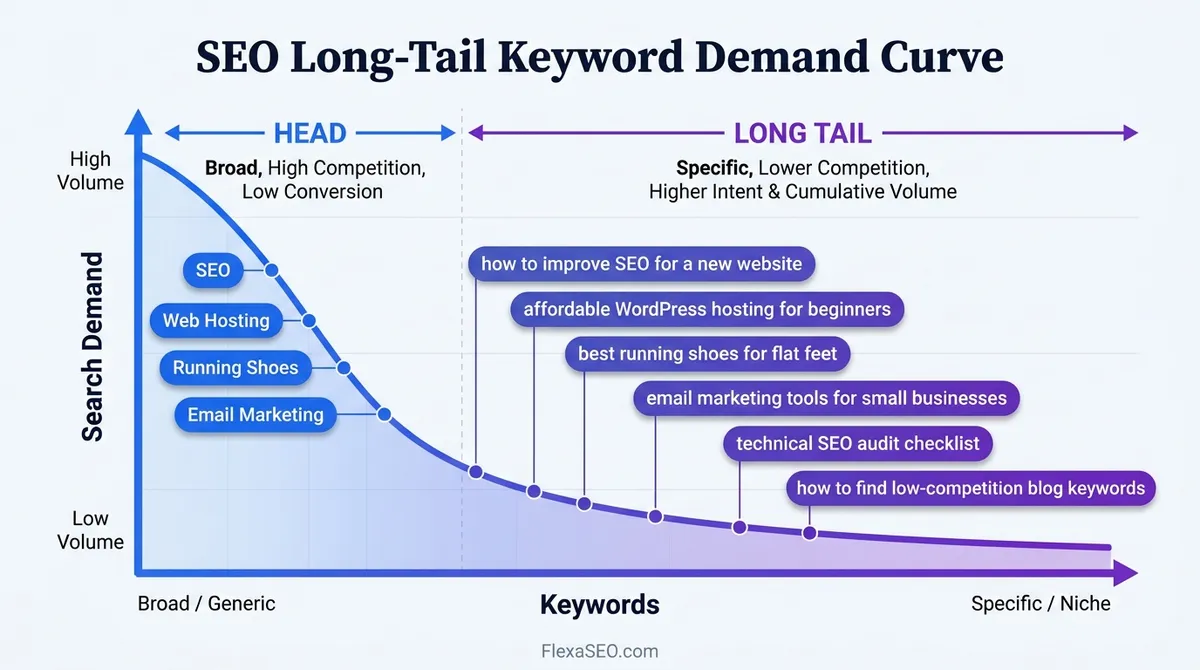
Even though one long-tail query might bring only 20 to 150 visits per month on its own, ranking for hundreds of relevant long-tail phrases compounds into steady, predictable organic traffic. For newer websites and lean publishing teams that cannot yet outrank established giants on head terms, that cumulative tail is often the fastest path to meaningful growth.
Long-Tail Keywords vs. Short-Tail Keywords#
Short-tail keywords (also called head terms) and long-tail keywords serve different roles in a mature SEO strategy. Seeing how they compare makes it much easier to match each query to the right page format.
| Feature | Short-Tail Keywords | Long-Tail Keywords |
|---|---|---|
| Typical length | Usually one to two words | Often three or more words |
| Specificity | Broad, multi-faceted topic | Focused question, audience, or use case |
| Search volume | High individual monthly demand | Lower individual demand, high cumulative volume |
| Competition | Usually intense and domain-heavy | Often lower with clearer SERP openings |
| Search intent | Mixed or ambiguous | Clear and actionable |
| Audience | Wide, exploratory audience | Qualified, niche segment |
| Conversion rate | Lower or mixed depending on intent | Often higher on commercial and transactional queries |
| Ideal content format | Pillar guides, category hubs, homepages | Tutorials, comparisons, troubleshooting posts, niche landing pages |
Think about a single head term like "laptops." A searcher could be hunting for gaming rigs, corporate fleet pricing, battery replacement services, or Chromebook reviews. A query like "best lightweight laptops for university students" narrows down form factor, weight, budget sensitivity, and user profile in one stroke.
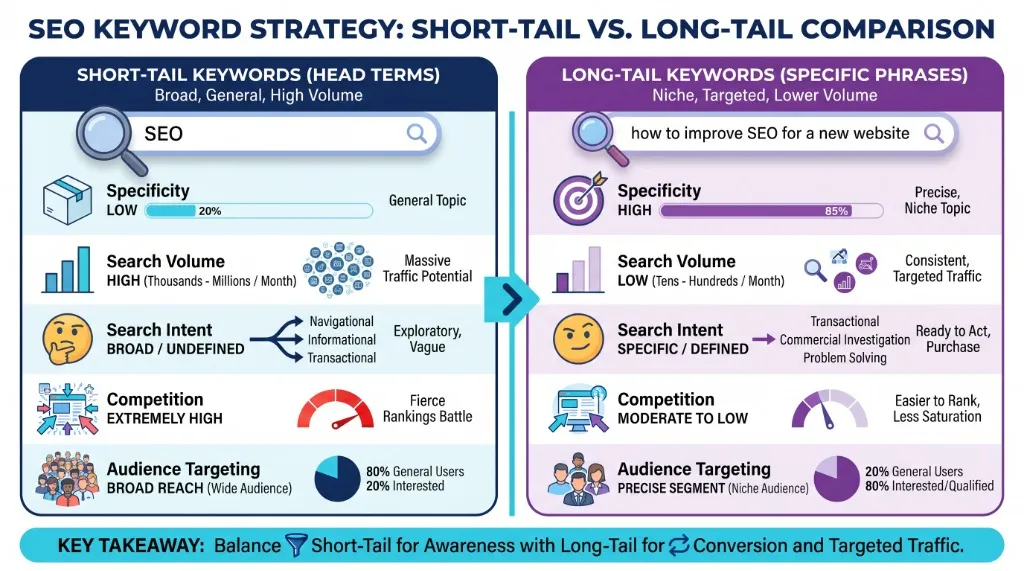
Neither keyword type replaces the other. Broad terms work best on foundational hub pages that anchor your topical authority, while long-tail keywords power the supporting articles, reviews, and tutorials that convert readers and feed internal link equity back to your hubs. For a deeper breakdown of how both types work together, see our full comparison of short-tail vs. long-tail keywords.
Why Long-Tail Keywords Matter for SEO#
Building part of your editorial calendar around long-tail queries delivers five compounding advantages for organic growth.
1. Lower Competition and Faster Wins
Head keywords are dominated by legacy publishers, marketplaces, and brands with thousands of referring domains. Narrower queries often have fewer pages tailored specifically to the searcher's exact angle, giving smaller or newer websites a realistic shot at page-one visibility.
Low monthly volume does not automatically guarantee low difficulty, though. Always inspect the live search results before committing time to a topic, because specialized software or medical queries can still be fiercely competitive even at 50 searches a month.
2. Clearer Search Intent Alignment
Understanding search intent means identifying why someone typed a query and what format they expect to see. Broad terms often blend definitions, tools, and agency services into a messy mixed SERP.
A long-tail query such as "how to run a technical SEO audit for a small Shopify store" leaves zero ambiguity. You know the exact platform, business scale, and step-by-step format required to satisfy the reader completely.
3. Stronger Conversion Potential
As queries grow more specific, searchers frequently move closer to a decision. Watch how intent sharpens across three variations in the same category:
- "Running shoes" signals early, unfocused browsing.
- "Best running shoes for marathon training" indicates active product comparison.
- "Buy lightweight marathon running shoes online" points to imminent purchase readiness.
Capturing visitors further along their journey naturally supports higher lead and sales rates, provided your product quality, pricing transparency, trust signals, and page speed deliver on the promise of the click.
4. Practical Entry Points for New and Small Websites
Launching a brand-new site by chasing "digital marketing" or "cloud hosting" rarely produces traffic in the first year. Starting with focused, underserved questions builds early impressions, earns natural backlinks, and proves topical relevance to search engines.
For example, a new marketing blog can gain early traction around topics like:
- How to write descriptive blog title tags for higher click-through rates
- How to compress website images without losing visual clarity
- How to structure internal links on a 20-page business site
- How to earn organic traffic in a niche with low backlink competition
5. Audience-Driven Content Ideas
Long-tail keyword research doubles as free customer discovery. Every modifier, comparison, and troubleshooting phrase reveals what your readers struggle with—helping you map out step-by-step tutorials, product comparisons, industry landing pages, and troubleshooting checklists around real demand instead of guesswork.
Four Types of Long-Tail Keywords#
Grouping long-tail keywords by intent helps you decide what kind of page to build for each phrase.
Informational Long-Tail Keywords
Informational queries come from readers who want clear answers, definitions, or instructions rather than a sales pitch. Educational guides, checklists, and how-to tutorials perform best here.
- How does keyword clustering improve topical authority?
- What is crawl budget in technical SEO?
- How to fix broken internal links after a site migration
- Why does page speed affect mobile search rankings?
Commercial Investigation Keywords
Commercial queries show that a buyer is actively evaluating options, comparing tools, or weighing pros and cons before committing. Detailed product reviews, comparison tables, and "best-of" roundups match this intent.
- Best free keyword research tools for beginner bloggers
- Ahrefs vs Semrush for small in-house SEO teams
- Lightweight WordPress SEO plugins compared
- Affordable email marketing platforms for bootstrapped startups
Transactional Long-Tail Keywords
Transactional phrases signal readiness to buy, book, subscribe, or sign up. These keywords belong on focused service pages, category pages, product listings, and pricing pages rather than generic blog posts.
- Buy managed WordPress hosting with daily backups
- Hire a technical SEO consultant for SaaS migrations
- Subscribe to an automated rank-tracking tool
- Order custom ergonomic office chairs with lumbar support
Conversational and AI-Era Long-Tail Keywords
More searchers now phrase queries as full natural-language questions—both in Google's search bar and inside AI search experiences.
- What is the easiest way to find low-competition keywords for a new blog?
- Which free SEO tools should a small business owner run first?
- How can a local service website get organic leads without a huge content budget?
Traditional keyword databases often report zero or minimal monthly volume for conversational prompts because each user words them slightly differently. Even so, addressing those exact questions clearly in subheadings and FAQ sections strengthens visibility in featured snippets and AI-assisted search answers.
How to Find Long-Tail Keywords: 8 Practical Methods#
You do not need expensive enterprise software to uncover strong long-tail opportunities. Combining search engine features, your own site data, community listening, and keyword tools gives you a reliable, repeatable workflow.
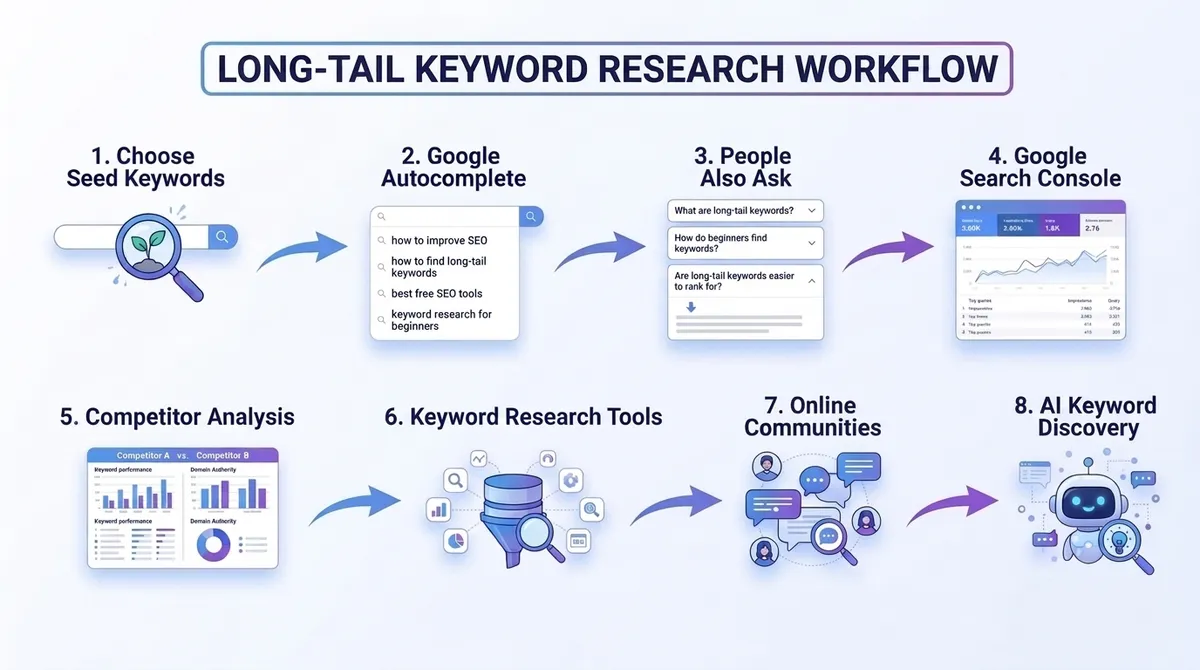
1. Expand Seed Keywords With Modifiers
Every strong keyword research workflow starts with broad seed topics that describe your core offerings or content pillars. If you run an SEO publication, your seeds might include technical SEO, link building, local SEO, on-page optimization, and SEO keywords.
From each seed, attach natural modifiers across four categories to generate specific angles:
- Question modifiers: "how to," "why does," "what is," "when should"
- Audience modifiers: "for beginners," "for SaaS," "for small businesses," "for Shopify"
- Comparison modifiers: "vs," "alternatives to," "best," "affordable," "free"
- Outcome or problem modifiers: "without backlinks," "checklist," "template," "step-by-step"
Keep your ideas organized in a spreadsheet with columns for target keyword, primary search intent, estimated demand, live SERP difficulty, and planned URL so you avoid overlapping topics later.
2. Mine Google Autocomplete
Google Autocomplete surfaces real search completions shaped by language patterns and active user behavior. It remains one of the fastest free ways to see how real people phrase their queries.
Follow this quick process:
- Open an incognito browser window so personalized search history does not bias results.
- Type your seed keyword followed by a space (for example, "keyword research ").
- Try the alphabet-soup technique by adding one letter at a time after the space ("keyword research a", "keyword research b", and so on).
- Place a question word or modifier before the seed ("how to do keyword research", "best keyword research").
- Record genuinely distinct phrases that align with your audience.
Treat autocomplete suggestions as validated phrasing ideas rather than proof of high search volume—you will still verify demand and competition in later steps.
3. Extract Questions From People Also Ask and Related Searches
People Also Ask (PAA) boxes reveal follow-up questions searchers ask immediately around a core query, while Google's related searches at the bottom of the page highlight closely connected subtopics.
Click two or three relevant PAA questions on a results page and watch Google dynamically expand even more specific long-tail questions underneath them. Rather than creating a separate 400-word post for every single question, group questions that share the same search intent as H2 or H3 subheadings inside one thorough, well-structured guide.
4. Uncover Hidden Queries in Google Search Console
If your website already receives impressions, Google Search Console (GSC) is a goldmine because it displays actual queries people typed before seeing your pages—including long-tail terms you never intentionally targeted.
To find quick wins in GSC:
- Open your property in Google Search Console and navigate to Search results under Performance.
- Enable Average CTR and Average position above the chart, then switch to the Queries tab.
- Filter for queries ranking between positions 8 and 20 ("striking-distance" keywords) with steady impressions.
- Apply a custom query regex filter such as
^(who|what|where|when|why|how)to isolate question-based long-tail terms.
When you spot a relevant long-tail query with high impressions and low clicks or page-two rankings, check which existing URL is ranking. Often, expanding a section or clarifying a heading on that existing page lifts rankings much faster than publishing a competing article.
5. Run a Competitor Keyword Gap Analysis
Competitor analysis lets you reverse-engineer long-tail keywords that already drive consistent traffic for sites similar in size or focus to yours.
Identify three to five direct organic competitors—especially smaller or mid-sized sites succeeding in your niche rather than giant media conglomerates—and inspect their organic keywords in Ahrefs or Semrush. Filter their keyword lists by word count (four or more words), lower keyword difficulty, or question modifiers.
Look specifically for topics where competitors rank on page one with thin, outdated, or poorly formatted pages. Your goal is never to rewrite what they published, but to deliver clearer answers, better visuals, and more practical examples.
6. Use Dedicated Keyword Research Tools
Dedicated SEO tools speed up discovery by surfacing estimated search volume, keyword difficulty, parent topics, and SERP snapshots in one place.
Google Keyword Planner gives free keyword ideas and broad monthly search ranges directly from Google Ads data. Keep in mind that its "Competition" column measures paid advertiser bidding intensity, not organic SEO ranking difficulty.
Ahrefs excels at uncovering long-tail angles through its Matching Terms, Questions, and Traffic Share reports, making it easy to estimate total topic potential rather than single-keyword volume.
Semrush offers granular filtering inside its Keyword Magic Tool—letting you slice thousands of keyword variations by search intent, question phrasing, broad match, and keyword difficulty in seconds.
Ubersuggest provides budget-friendly keyword suggestions, SEO difficulty estimates, and basic competitor overviews suited to solo creators and small businesses.
AnswerThePublic visualizes real autocomplete questions, prepositions, and comparisons around any seed term, making it especially handy when outlining comprehensive guides and FAQ sections.
Pick one or two tools that fit your budget and workflow. Reliable keyword research depends far more on smart filtering and SERP observation than on subscribing to every platform at once.
7. Listen to Online Communities and Forums
People rarely speak in polished SEO phrases when asking for help online. They describe pain points, edge cases, and frustrations in plain language across Reddit threads, Quora questions, Facebook groups, and niche support forums—often well before keyword tools catch up.
Use Google search operators to surface authentic community discussions around your topic:
Scan recurring complaints and follow-up replies where existing guides left people confused. Those exact phrases often make high-converting subheadings, tutorial topics, and FAQ entries once you validate demand against search results.
8. Brainstorm Angles With AI Tools
AI assistants can quickly expand a seed topic into dozens of audience-specific scenarios, objections, and question variations you might overlook on your own. Try a focused prompt like this:
"Act as an SEO content strategist. Suggest 30 specific long-tail keyword angles for a website helping small eCommerce stores improve organic traffic. Group ideas into informational, commercial comparison, and transactional intent, avoiding duplicate topics.
Never publish blindly off an AI-generated keyword list. Treat every output as a brainstorming hypothesis and verify actual user demand, phrasing, and page-one competition in Google and your keyword tools before writing.
How to Choose the Best Long-Tail Keywords#
Gathering hundreds of keyword ideas takes ten minutes; picking the ones worth building pages around is what drives results. Filter every candidate through these five criteria.
Search Intent Match
Confirm that the content format you want to create matches what already ranks on page one. If all top results for a query are interactive calculators or category pages, a 2,000-word blog essay will struggle to rank no matter how well written it is.
Realistic Search Volume and Zero-Volume Nuance
Search volume estimates show directional demand, not exact visitor counts. Do not automatically discard ultra-specific queries marked with "0–10" monthly searches if they clearly reflect high-intent buyer questions or emerging trends—those estimates often lag behind real search behavior.
At the same time, ensure the broader topic carries enough combined demand to justify dedicated effort.
Keyword Difficulty vs. Live SERP Reality
Third-party keyword difficulty (KD) scores typically estimate backlink strength on top-ranking pages, and every tool calculates them differently. Treat KD as a quick initial filter, then spend 60 seconds inspecting the live SERP yourself.
Signs of an approachable long-tail SERP include Reddit or Quora threads ranking in the top five, outdated tutorials from several years ago, or pages that only partially answer the user's specific qualifier.
Business Relevance
Traffic only moves the needle when the right people click. A B2B SaaS analytics company might easily rank for a generic spreadsheet shortcut, yet gain zero product signups from that audience. Prioritize long-tail topics where your product, service, or core expertise provides the natural next step.
Total Page Traffic Potential
One thorough, well-structured page rarely ranks for a single phrase—it commonly captures impressions across dozens of closely related long-tail variations. Evaluating the total traffic of the current top-ranking page gives a far truer picture of opportunity than staring at one isolated monthly search number.
How to Use Long-Tail Keywords in Your Content#
Once you choose a strong primary query and its closely related variations, integrate them cleanly without sacrificing readability. Follow these practical guidelines:
- Write a clear, compelling page title and check how it looks in search results using our SERP Preview Tool.
- Structure one descriptive H1 and logical H2 and H3 subheadings, then validate hierarchy with the Heading Structure Checker.
- Address the reader's core question early in the introduction before diving into background theory.
- Assign related secondary phrases and follow-up questions naturally to subheadings where they expand the topic.
- Keep explanations concise and actionable rather than padding sections to hit an arbitrary word count.
- Link strategically to related guides and tools—review our On-Page SEO Guide for anchor text and placement tips.
- Write accurate alt text describing every diagram or screenshot, and inspect media attributes with the Image SEO Analyzer.
- Write for human clarity first and verify natural keyword distribution with our Keyword Density Checker, or run a full URL check in the SEO Analyzer.
Modern search systems understand synonyms, closely related entities, and topical context. You do not need to force an awkward exact-match phrase into every paragraph—focus on answering the query thoroughly and naturally.
Organizing Long-Tail Content Into Topic Clusters
Rather than publishing disconnected one-off posts, organize your long-tail articles into topic clusters. A broad pillar page covers the main head term from top to bottom, while individual long-tail articles dive deep into specific subtopics and link directly back to the pillar and to one another.
This hub-and-spoke layout makes it easier for both readers and search engine crawlers to navigate your expertise while preventing multiple pages from competing for the same query.
8 Common Long-Tail Keyword Mistakes to Avoid#
Even experienced teams run into avoidable setbacks when building long-tail strategies. Watch out for these eight pitfalls.
1. Defining Long-Tail Keywords Strictly by Word Count
A five-word query can still be fiercely competitive, while a specialized two-word phrase can represent a quiet niche opportunity. Always judge by relative demand, specificity, and SERP competition rather than counting words.
2. Skipping the Live SERP Intent Check
Keyword tools sometimes mislabel intent or lag behind shifts in what Google rewards. Opening an incognito search tab and reviewing the top five results takes under a minute and prevents months of wasted writing.
3. Chasing Traffic With Zero Business Fit
High-impression informational posts feel rewarding in analytics charts, yet add little value if those visitors never need what you offer. Keep a clear line between your target topics and your website's core purpose.
4. Splitting One Intent Across Multiple Thin Pages
Creating separate posts for "how to find long-tail keywords" and "ways to discover long-tail keywords" splits backlinks, confuses search engines, and triggers keyword cannibalization. Merge queries with matching intent into one authoritative page.
5. Treating Keyword Difficulty Scores as Absolute Truth
A low KD score can hide a SERP locked down by brand domains, video carousels, or government sites, while a medium KD score might reflect weak, outdated articles ripe for replacement. Always verify visually.
6. Dismissing Low-Volume or Zero-Volume Queries
Many profitable SaaS, technical, and high-ticket service keywords show almost zero monthly volume in third-party databases. If customers ask those questions on sales calls or in support tickets, they are worth answering.
7. Stuffing Exact-Match Phrases Into Every Paragraph
Repeating clunky five-word phrases verbatim ruins readability and risks triggering spam signals. Use natural phrasing, pronouns, and closely related terminology once the primary topic is clearly established.
8. Publishing Without Reviewing Search Console Data
Publishing is only step one. Reviewing Google Search Console every month or quarter reveals surprising long-tail queries your post already ranks for on page two—telling you exactly which sections to expand next.
Frequently Asked Questions#
What is an example of a long-tail keyword?
An example of a long-tail keyword is "best free keyword research tools for beginner bloggers." Compared with a broad term like "keyword research tools," it specifies budget, experience level, and audience, making both search intent and competition much clearer.
How many words does a long-tail keyword have to be?
There is no strict word-count rule. Many long-tail keywords contain three or more words, yet what truly defines a long-tail term is its topical specificity and relatively low individual search demand compared with head terms in the same niche.
Are long-tail keywords always easier to rank for?
Not automatically, though they often face less direct competition than broad terms because fewer pages address narrow user requirements. You should still check the live search results to inspect domain authority, content depth, and intent alignment before targeting any phrase.
Are long-tail keywords good for new websites?
Yes, targeting long-tail queries is one of the smartest ways for a new website to earn early organic traffic. Focusing on underserved questions helps you demonstrate topical depth and build momentum without immediately going head-to-head against entrenched brands.
Can I find long-tail keywords without paid SEO tools?
Yes, you can uncover plenty of long-tail ideas using free resources such as Google Autocomplete, People Also Ask boxes, Related Searches, Google Search Console, Google Keyword Planner, and online communities like Reddit. Paid platforms simply accelerate filtering and competitor analysis as you scale.
What is the main difference between short-tail and long-tail keywords?
Short-tail keywords are broad, one- or two-word topics with high search volume, mixed intent, and heavy competition. Long-tail keywords are narrower, more descriptive queries with lower individual search volume, clearer intent, and typically stronger conversion potential.
Should every blog post target a long-tail keyword?
Not necessarily. Long-tail keywords work best for focused tutorials, comparisons, and specific problem-solving guides, whereas broad head or middle-tail topics still deserve comprehensive pillar pages when you are mapping out an entire subject area.
How many long-tail keywords should I target on one page?
Focus each page on one primary keyword topic and naturally include closely related variations that share the exact same search intent. A single well-structured guide often ranks for dozens of phrasing variations without forcing separate keywords into awkward headings.
Do long-tail keywords help with AI search visibility?
Yes, researching long-tail and conversational queries reveals the exact natural-language questions audiences ask AI search tools. Pairing that question focus with clear formatting, accurate facts, and direct answers improves your odds of being cited alongside traditional search rankings.
How often should I refresh my long-tail keyword research?
Review keyword opportunities whenever you plan a new content cluster, launch a product or service, or notice traffic shifts. Checking Google Search Console monthly for emerging queries ranking on pages two and three is a practical habit for steady updates.
Conclusion#
Long-tail keywords give you a direct window into what your audience wants to learn, compare, or buy. Instead of fighting entrenched websites over vague one-word terms, you can meet searchers at the exact moment they articulate a specific need.
Start with clear seed topics, explore Google Autocomplete and People Also Ask, review Search Console data for hidden impressions, and verify every candidate against live search results. Above all, prioritize search intent, business relevance, and total traffic potential over raw search-volume numbers alone.
When every article answers a genuine audience question with clarity and depth, long-tail keywords turn into a reliable foundation for compounding organic growth.