Short-Tail vs Long-Tail Keywords: What's the Difference?
Compare short-tail and long-tail keywords with real industry examples, search intent breakdowns, and a practical topic-cluster strategy for lasting SEO growth.

Choosing the right keywords is one of the highest-leverage decisions in any SEO strategy. Yet not all search terms behave alike: some attract tens of thousands of broad queries every month, while others draw modest traffic from visitors who know precisely what they want.
That distinction sits at the center of short-tail vs. long-tail keywords. Understanding how both keyword types work helps you uncover realistic ranking opportunities, decode audience intent, and match every page on your site to traffic that actually converts—whether you are starting from zero or expanding an established domain. For a foundational overview of how search terms fit into organic optimization, start with our guide to SEO keywords.
Consider the contrast between searching for "SEO tools" and typing "best free SEO tools for small business websites." The first searcher might be browsing definitions or enterprise platforms; the second has already defined their budget, business size, and goal. In this guide, you will learn how short-tail and long-tail keywords differ, when to target each, and how to combine both into a balanced strategy for lasting organic growth.
What Are Short-Tail Keywords?#
Short-tail keywords—often called head terms—are broad, general search queries that typically consist of one or two words. They name an overarching subject, product category, or industry rather than a specific question or requirement.
Because they sit at the top of search demand, short-tail keywords usually attract substantial monthly search volume:
- SEO
- Digital marketing
- Web hosting
- Running shoes
- Email marketing
- Cloud computing
- Keyword research
That breadth comes with a major trade-off: ambiguity. Someone searching "web hosting" might be comparing managed providers, learning what a server does, hunting for cheap shared plans, or troubleshooting downtime. One short phrase rarely reveals what the searcher expects on the page.
Characteristics of Short-Tail Keywords
- High Search Volume: Broad head terms capture large numbers of monthly searches, giving top-ranking pages wide visibility.
- Intense Competition: Established brands, major publications, and authoritative domains dominate page one, meaning you typically need deep topical authority and strong backlinks to compete.
- Mixed Search Intent: One query can simultaneously represent informational, commercial, and navigational goals across different users.
- Low Specificity: Without qualifying modifiers, it is harder to tailor a single page so it satisfies every potential visitor.
- Large Traffic Ceiling: Reaching the top three positions on a major head term can deliver massive ongoing visits, depending on SERP features and click-through rate.
Short-Tail Keyword Examples
| Short-Tail Keyword | Possible Search Intent |
|---|---|
| SEO | Learning how search engine optimization works |
| WordPress | Exploring the WordPress CMS platform or logging in |
| Backlinks | Understanding link building concepts and value |
| Web hosting | Comparing hosting types and providers |
| Cybersecurity | Researching online security fundamentals or tools |
| Digital marketing | Exploring online marketing channels and careers |
| Email marketing | Learning about newsletter tools and campaign strategies |
Short-tail keywords belong primarily on foundational pillar pages, main category hubs, service overviews, and homepages rather than narrow blog tutorials.
What Are Long-Tail Keywords?#
Long-tail keywords are specific, focused search queries that generally attract lower individual search volume than broad head terms. While they frequently contain three or more words, length alone is not what defines them—some niche two-word technical terms are long-tail, while certain four-word consumer phrases receive huge search volume. What truly sets long-tail keywords apart is higher specificity and lower relative search demand compared with the head of a topic.
Look at how clearly the searcher's goal comes through in these examples:
- Best free SEO tools for beginners
- How to improve website loading speed in WordPress
- Best web hosting for small business websites
- How to build backlinks for a new website
- Ways to reduce electricity consumption at home
Someone searching "best free SEO tools for beginners" is not looking for a textbook definition of SEO. They want approachable, zero-cost software recommendations tailored to newcomers.
Characteristics of Long-Tail Keywords
- Lower Individual Search Volume: Each phrase may receive only dozens or hundreds of monthly searches, yet hundreds of related phrases add up to substantial cumulative traffic.
- Clearer Search Intent: Modifiers often expose the searcher's exact pain point, budget, experience level, or desired format.
- Often Lower Competition: Fewer pages target narrow requirements directly, giving newer or smaller websites realistic page-one openings—though you should always verify competition in live search results.
- Tighter Audience Fit: Focused pages answer the exact question at hand instead of skimming a broad topic superficially.
- Stronger Conversion Potential: Queries containing commercial or action qualifiers such as "best," "compare," "pricing," or "buy" often bring visitors closer to a purchase or signup.
Long-Tail Keyword Examples
| Long-Tail Keyword | Likely Search Intent |
|---|---|
| Best free SEO tools for beginners | Evaluating beginner-friendly free software |
| How to improve website loading speed | Fixing slow Core Web Vitals or page performance |
| Best WordPress hosting for small businesses | Comparing reliable small-business hosting plans |
| How to get backlinks for a new website | Learning starter link-building tactics |
| Affordable email marketing tools for startups | Comparing budget-friendly email platforms |
| How to reduce electricity bills at home | Finding practical home energy-saving steps |
Long-tail keywords fit naturally on step-by-step tutorials, product comparisons, troubleshooting guides, FAQs, and targeted use-case landing pages.
Short-Tail vs. Long-Tail Keywords: Key Differences#
Although both keyword types support organic growth, they perform very different jobs across your site architecture. Here is how they compare side by side:
| Factor | Short-Tail Keywords | Long-Tail Keywords |
|---|---|---|
| Typical length | Usually 1 to 2 words | Often 3 or more words |
| Search volume | High individual monthly demand | Lower individually, substantial collectively |
| Competition | Usually domain-heavy and intense | Often lower with clearer SERP gaps |
| Search intent | Broad or mixed | Specific and actionable |
| Audience reach | Wide, early-stage audience | Narrow, qualified segment |
| Ranking difficulty | Challenging for newer sites | More attainable with focused content |
| Conversion potential | Varies widely by query | Often stronger on commercial terms |
| Best content format | Pillar guides, category hubs | Tutorials, comparisons, FAQs, niche pages |
| Traffic pattern | Concentrated in a few terms | Distributed across dozens of queries |
| Primary strategic role | Topical authority and broad reach | Targeted traffic and conversions |
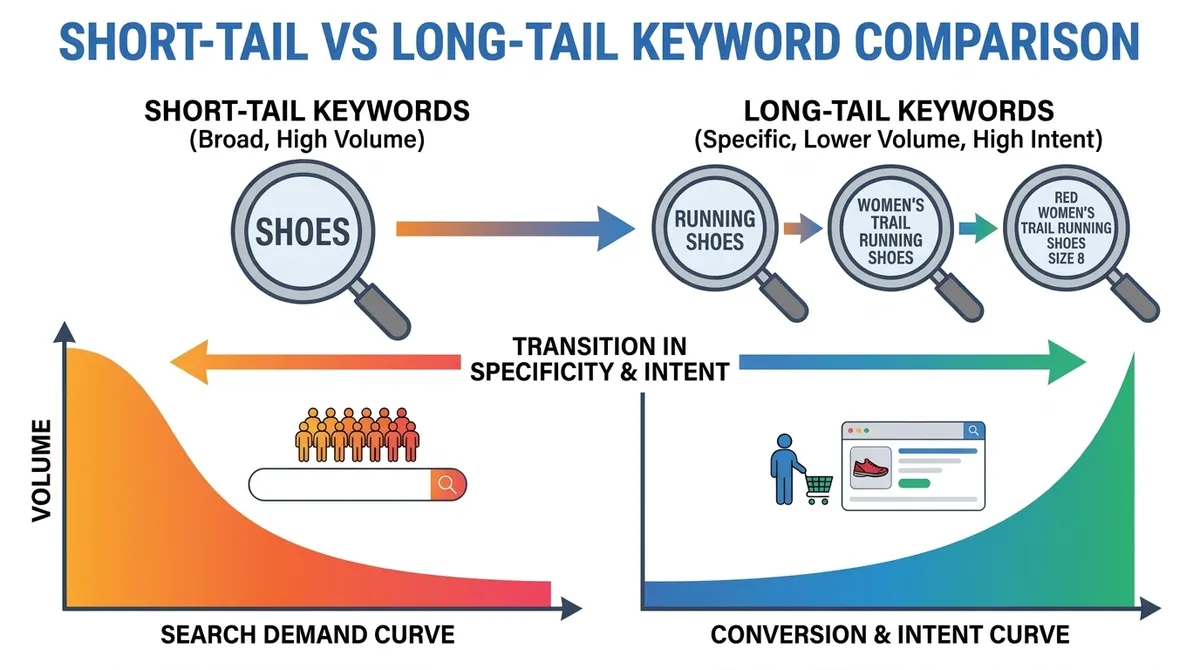
Keep in mind that these are practical patterns rather than rigid SEO rules. A long query in a lucrative software or finance niche can still be fiercely competitive, while a specialized short acronym might have surprisingly light competition. Always let live SERP analysis, search intent, and business fit guide your final call.
Short-Tail vs. Long-Tail Keywords: Practical Industry Examples#
Seeing how head terms branch into long-tail opportunities across different industries makes content planning much more concrete.
SEO Industry
- Short-tail keyword: SEO
- Long-tail keywords: "how does SEO work for beginners," "best SEO strategies for small business websites," "how to improve Google search rankings organically," "free SEO tools for keyword research"
A broad pillar guide introduces the discipline as a whole, while individual long-tail articles solve each specific workflow step in depth.
Web Hosting Industry
- Short-tail keyword: Web hosting
- Long-tail keywords: "best web hosting for WordPress beginners," "affordable VPS hosting for small businesses," "shared hosting vs VPS hosting for new websites," "how to choose a reliable web hosting provider"
A hosting brand can anchor its category hub on the head term while capturing comparison and buyer traffic through focused guides.
Fitness Industry
- Short-tail keyword: Weight loss
- Long-tail keywords: "beginner workout plan for weight loss at home," "healthy high-protein breakfast ideas for weight management," "how to restart exercise after a long break," "low-impact home workouts for beginners"
Instead of competing head-on with giant health portals, focused guides speak directly to the reader's constraints and fitness level.
Cloud Technology Industry
- Short-tail keyword: Cloud computing
- Long-tail keywords: "AWS vs Azure vs Google Cloud for beginners," "what is cloud computing and how does it work," "best cloud certification for entry-level engineers," "how to deploy a Node app on cloud VPS"
Each specific phrase isolates an exact decision stage—from conceptual learning to vendor comparison and hands-on implementation.
Which Keywords Are Better for SEO?#
Neither keyword type wins universally. The smarter choice depends on your domain authority, competitive landscape, timeline, and business model—though newer sites almost always gain traction faster by starting with long-tail opportunities.
When to Target Short-Tail Keywords
Short-tail terms make sense when:
- Your site has already built credible domain authority and backlink support.
- You want broad visibility around a core product category or industry pillar.
- You are building comprehensive hub pages, glossaries, or top-level service landing pages.
- You have the editorial depth to outlast established competitors over time.
When to Target Long-Tail Keywords
Long-tail terms are the stronger fit when:
- Your website is newer or competes against high-authority national brands.
- You want faster page-one wins around specific questions and problems.
- You are publishing tutorials, tool comparisons, troubleshooting walkthroughs, or buyer guides.
- You want visitors whose search phrasing signals immediate relevance to your tools or services.
The Best Approach: Combine Both
The most resilient SEO strategies do not pick sides. Use short-tail keywords to define your core topic hubs, then surround each hub with long-tail articles that explore subtopics thoroughly and link back to the main page. Over time, traffic and internal links from those long-tail wins lift your ability to rank for the broader head terms too.
How to Find Short-Tail and Long-Tail Keywords#
You can uncover both broad topic pillars and high-intent long-tail angles using a straightforward six-step keyword research workflow.
1. Start With Google Autocomplete
Type a broad seed phrase like "SEO tools for" into Google in an incognito window and watch what real users search next—suggestions like "SEO tools for beginners," "SEO tools for small businesses," and "SEO tools for keyword research" give you instant, audience-tested subtopics.
2. Mine Google's People Also Ask Box
Search a head term and inspect the People Also Ask questions on page one. Clicking relevant questions dynamically loads even more specific long-tail queries that you can turn into article subheadings, FAQ sections, or standalone guides when intent differs.
3. Use Dedicated Keyword Research Tools
Platforms like Google Keyword Planner, Google Search Console, Ahrefs, Semrush, and Ubersuggest help quantify search demand, keyword difficulty, and existing impressions. You do not need every paid suite at once—start with Google's free tools and expand only as your publishing volume grows.
4. Analyze Competitor Websites
Inspect three to five direct organic competitors in your niche. Review their top-traffic pages, blog headings, and multi-word rankings to spot narrow questions they covered poorly or missed altogether, then build a clearer, more complete resource.
5. Check Related Searches
Scroll to the bottom of Google's results page for Related Searches. A query like "web hosting" routinely surfaces adjacent branches such as "WordPress hosting," "VPS hosting," and "cloud hosting," giving you ready-made subtopics to drill into further.
6. Listen to Forums and Online Communities
Reddit threads, Quora questions, niche Slack groups, and developer forums reveal real-world phrasing before keyword databases even record measurable search volume. Recurring complaints and step-by-step questions make standout editorial topics once you validate intent in Google.
How to Choose the Right Keywords for Your Website#
Gathering raw keyword ideas is easy; picking targets that actually grow your site requires filtering every candidate through five criteria.
1. Search Volume
Monthly search volume estimates directional demand. Avoid chasing high numbers blindly: a query with 120 targeted monthly searches that matches your product or tool often outperforms a vague 10,000-search term whose visitors bounce immediately.
2. Keyword Difficulty
Keyword difficulty scores estimate how hard it is to reach page one based largely on competing backlinks. Always confirm the number manually by checking the authority of ranking domains, how thoroughly top pages answer the query, and whether weak forum posts or outdated articles hold spots you can beat.
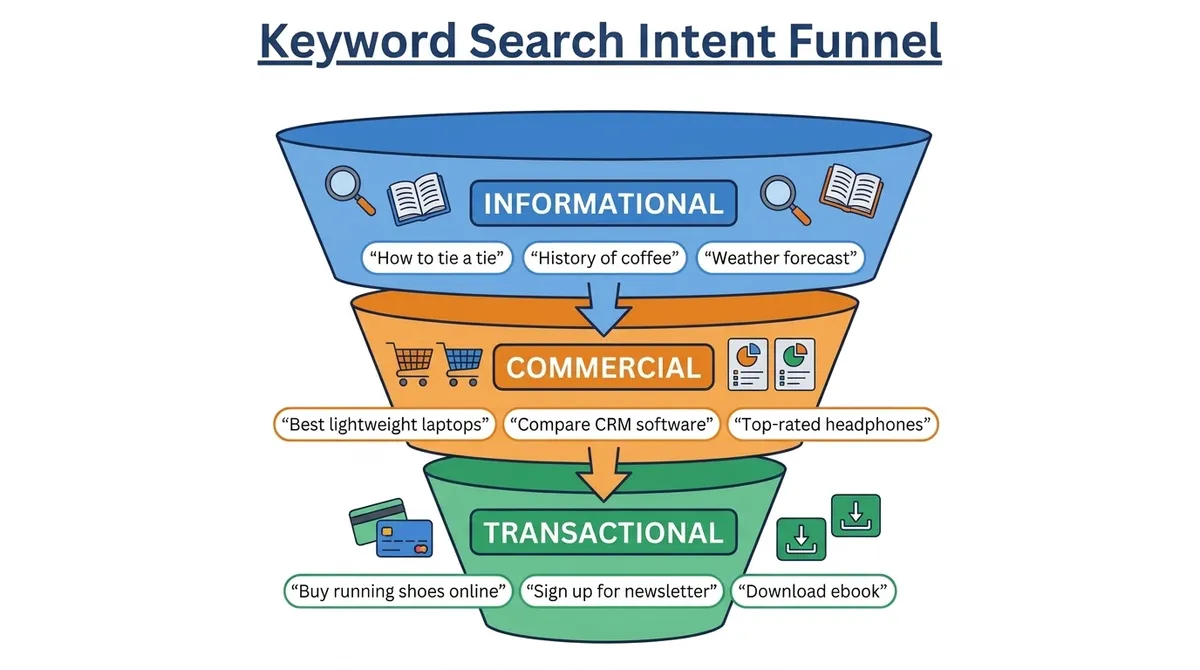
3. Search Intent
Understanding search intent ensures your page format matches what searchers expect. A keyword with healthy volume will still flop if you publish a glossary definition where Google rewards a comparison table.
| Search Intent | Primary Goal | Example Query |
|---|---|---|
| Informational | Learn an answer or process | What is keyword research? |
| Navigational | Reach a known site or tool | Google Search Console login |
| Commercial | Compare products or solutions | Best SEO tools for beginners |
| Transactional | Buy, book, or sign up | Buy managed WordPress hosting |
4. Business Relevance
Verify that every chosen keyword connects logically to what your website offers. Traffic only compounds into growth when visitors recognize a clear next step—whether trying a free tool, reading a related playbook, or evaluating your service.
5. Traffic Potential
Instead of judging a topic by one keyword's isolated search volume, examine the total organic traffic earned by the current top-ranking page. One thorough article targeting a clear long-tail angle frequently ranks for dozens of close phrasing variations simultaneously.
How to Build a Keyword Strategy Using Both Types#
The cleanest way to unite short-tail and long-tail keywords is a topic cluster architecture. You build one comprehensive pillar page targeting a broad head term, surround it with focused long-tail articles covering specific questions or comparisons, and link the cluster together cleanly.
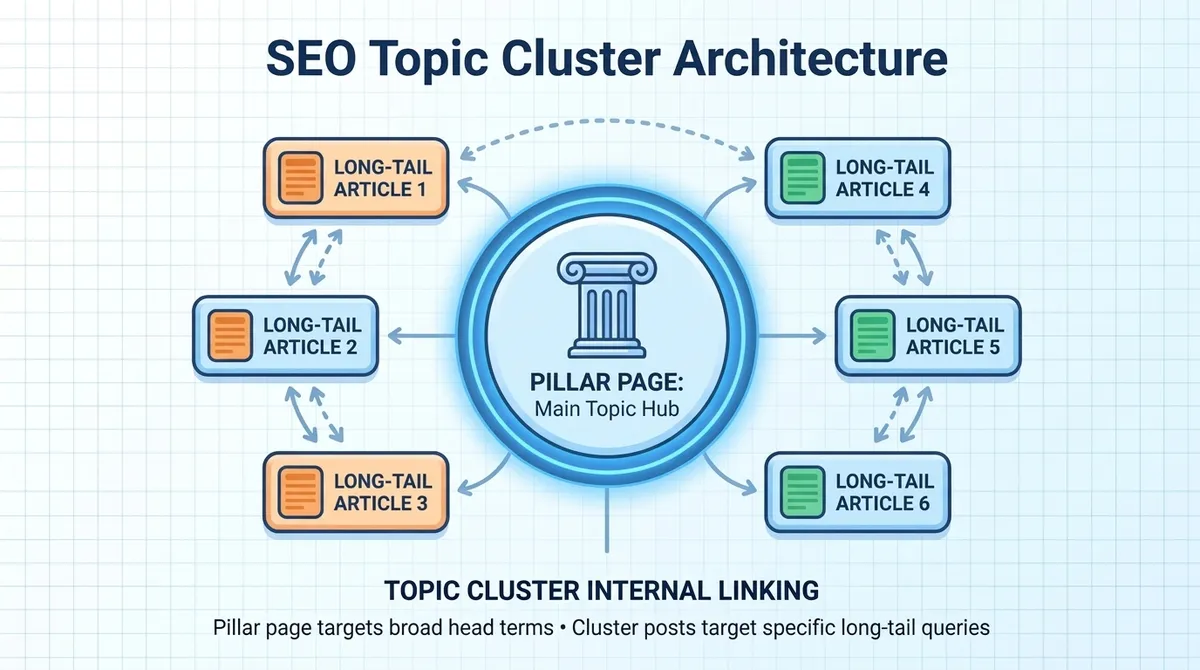
Here is how that structure looks in practice for a keyword research topic cluster:
| Content Type | Target Keyword | Strategic Purpose |
|---|---|---|
| Pillar page | Keyword research | Comprehensive end-to-end hub guide |
| Supporting article | Long-tail keywords | Deep dive into finding niche queries |
| Supporting article | Short-tail vs long-tail keywords | Side-by-side strategy comparison |
| Supporting article | Keyword difficulty | Practical tutorial on evaluating SERPs |
| Supporting article | Low-competition keywords | Actionable discovery playbook |
| Supporting article | Search intent | Educational guide to query intent |
When structuring each page, follow clean on-page SEO practices: keep one descriptive H1, verify logical subheadings with the Heading Structure Checker, maintain natural phrasing with our Keyword Density Checker, and audit the finished page with the SEO Analyzer.
7 Common Keyword Targeting Mistakes to Avoid#
Even thoughtful content teams run into predictable traps when balancing head terms and long-tail queries. Avoid these seven missteps:
1. Choosing Keywords Strictly by Search Volume
High monthly search numbers mean nothing if competition is unreachable or visitors have zero interest in your site. Balance demand against realistic ranking odds and relevance.
2. Ignoring Long-Tail Opportunities
Chasing only prestigious one- or two-word terms leaves newer websites invisible for months while overlooking steady, high-intent queries sitting right within reach.
3. Stuffing Exact-Match Keywords
Forcing awkward multi-word phrases verbatim into every paragraph makes writing robotic and can trigger spam signals. Write naturally and rely on clear headings, synonyms, and helpful explanations.
4. Targeting the Same Intent Across Multiple Pages
Publishing separate articles for "short-tail vs long-tail keywords" and "long-tail vs short-tail SEO differences" splits internal links and causes keyword cannibalization. Merge overlapping angles onto one authoritative URL.
5. Ignoring Live SERP Intent
Never rely purely on tool tags to guess intent. Open the live search results and check whether top pages are tutorials, listicles, tools, or product pages before writing a single paragraph.
6. Assuming Every Long Query Is Low Competition
Word count alone never guarantees an easy SERP. Some ultra-specific queries in software, legal, or health categories are guarded by major brands with deep editorial authority.
7. Never Updating Your Keyword Strategy
Search behavior and SERP competition evolve constantly. Review Google Search Console regularly to find pages ranking in positions 8 through 20 and expand them around emerging long-tail queries they already attract.
Frequently Asked Questions#
What is the main difference between short-tail and long-tail keywords?
Short-tail keywords are broad, one- or two-word topics with high individual search volume and mixed intent, while long-tail keywords are narrower, more specific queries with lower individual volume and clearer searcher intent. Both play complementary roles across hub and supporting pages.
Are long-tail keywords better for SEO?
Long-tail keywords are not universally better, though they often deliver faster wins for newer websites and commercial pages because competition is more focused. The best target always depends on search intent, live SERP competition, and your site's existing authority.
How many words should a long-tail keyword have?
Long-tail keywords commonly contain three or more words, yet there is no strict word-count threshold. A keyword qualifies as long-tail based on its narrow topical specificity and lower relative search demand compared with broader head terms in the same market.
Do long-tail keywords always have lower competition?
Many long-tail queries face less direct competition because fewer publishers tailor pages to specific qualifiers, but this is not guaranteed. Always inspect the live search results, domain strength, and content depth on page one before selecting a target.
Can short-tail keywords generate more website traffic?
Yes, ranking in the top three positions for a popular short-tail keyword can bring substantial organic traffic from a single URL. However, earning and holding those rankings typically requires strong domain authority, backlinks, and comprehensive supporting content.
Should new websites start with long-tail keywords?
Yes, focusing on long-tail keywords is usually the most practical starting strategy for new websites. Answering specific, lower-competition questions helps build early search impressions, topical relevance, and natural backlinks before tackling broad head terms.
Can I target short-tail and long-tail keywords in the same article?
Yes, a comprehensive pillar guide often targets a broader primary keyword while naturally covering closely related long-tail questions in its subheadings. Just ensure every section shares consistent search intent rather than cramming unrelated topics onto one page.
What tools can I use to find short-tail and long-tail keywords?
Free options like Google Autocomplete, People Also Ask, Related Searches, Google Search Console, and Google Keyword Planner cover most discovery needs. Dedicated tools such as Ahrefs, Semrush, and Ubersuggest add deeper difficulty estimates and competitor keyword gap data.
Do long-tail keywords have higher conversion rates?
They frequently convert better because specific modifiers like "best," "affordable," or "for small businesses" indicate a visitor closer to making a decision. Actual conversion performance still depends on landing page clarity, trust signals, pricing, and product fit.
How many keywords should I target in one blog article?
Anchor each article on one primary keyword topic alongside a small set of closely related secondary variations that share the same search intent. Covering the subject thoroughly with clear structure will naturally earn rankings for dozens of related queries.
Conclusion#
Understanding the difference between short-tail and long-tail keywords helps you build an SEO strategy rooted in realistic opportunities rather than guesswork. Short-tail terms anchor your main topic hubs and broad brand visibility, while long-tail queries capture qualified visitors looking for clear answers, comparisons, and solutions.
Instead of treating them as competing strategies, combine both through structured topic clusters: build strong pillar pages around core subjects, support them with targeted long-tail guides, and connect everything with helpful internal links. Above all, prioritize search intent, editorial quality, and genuine reader value—because sustainable SEO is about bringing the right visitors to the right page at the exact moment they need it.